
China has been visa-free for Australian passports for approaching two years. Most Australians still don’t know.
The policy arrived quietly in November 2024, was extended again in November 2025, and now runs through the end of 2026. For most of that window it sat in a strange quiet — a handful of curious early adopters, a lot of silence. The last few months have flipped. The messages have picked up. Friends, clients, friends of clients, people who last visited China pre-2019 and assume the rules haven’t moved. They all ask us roughly the same three questions. This is the post we wish we could send back every time.
What the policy actually is
Short version: if you hold an ordinary Australian passport, you can enter mainland China without a visa for up to 30 days. No application, no declaration, no fee. Valid purposes are tourism, business (meetings, trade), visiting friends and family, or transit. The passport needs at least six months of validity from your return date.
The policy was first announced at 15 days in mid-2024, bumped to 30 days on 30 November 2024, and extended through 31 December 2026 on 5 November 2025. You can enter multiple times — there’s no cap on the number of visits, and no cap on total days per year. Just a hard 30-day limit per entry.
One exclusion worth flagging: diplomatic and official passport holders still need a visa. This post is about the ordinary passport — the one most people reading this actually have.
The authoritative source is the Chinese Embassy in Australia’s own notice page at au.china-embassy.gov.cn. Bookmark it.
The three worries we hear every time
”Isn’t it unsafe? Won’t I be watched?”
This is the one we hear most, and it almost never survives contact with reality. China is one of the lowest-crime destinations in the world for tourists — violent crime against foreigners is rare to the point of being statistically negligible. DFAT currently advises “exercise normal safety precautions” for the regions we work in. Nothing elevated.
Surveillance exists. Cameras are everywhere. But it’s ambient infrastructure aimed at domestic behaviour — traffic offences, civil disputes, missing persons — not at you reading a menu in Dali. No-one is watching your Instagram drafts. No-one cares what you ordered at breakfast. Ordinary leisure travel carries essentially zero political risk for Australians, and has for a long time.
The risks that are actually worth planning around are the ones you’d plan for anywhere: traffic in tier-one cities, altitude if you’re heading into Yunnan’s highlands or western Sichuan, the usual pickpocket awareness in crowds. Old-fashioned travel hygiene — not geopolitics.
”I don’t speak Mandarin. I’ll be stranded.”
You won’t. 2026 is the easiest year in modern history to travel China without the language.
WeChat has a built-in live-camera translator — point your phone at a menu, a bus stop sign, a train board, and it overlays English in real time. Alipay now ships in 16 languages natively. Metros, high-speed rail stations, and international airports all run English signage as standard. Google Translate works offline if you pre-download the Chinese pack before you fly.
The one percent of conversations that need more than a phone — a local guesthouse host in a village, an elderly taxi driver — get solved by pointing, smiling, and typing into the keyboard. Locals are overwhelmingly warm to travellers who try. We’ve watched people with zero Mandarin order bespoke noodle bowls in county towns. It works.
”The Great Firewall. I’ll lose Google, WhatsApp, Instagram.”
Only if you make no plan. With even a minute of preparation, this stops being an issue.
Three ways around it, in order of ease:
- International roaming from your Australian carrier. Your data traffic tunnels back through a non-Chinese network, which means Google, Gmail, WhatsApp, Instagram, and the rest all work natively — no VPN needed. Telstra, Optus, and Vodafone roaming all behave this way. For most short trips this is the simplest answer.
- A travel eSIM from Airalo, Holafly, or similar, bought before you fly. Same effect — your traffic doesn’t touch the Chinese firewall.
- A paid VPN installed before you land. Critical word: before. The Chinese app stores remove VPN apps once you’re inside the country, so install and test yours while you’re still in Australia.
The firewall only bites people who buy a local Chinese SIM, rely on it exclusively, and do no prep. Everyone else barely notices.
The border at Chengdu and Kunming
Both Chengdu Tianfu and Kunming Changshui now run dedicated visa-free lanes — signposted in English from the moment you step off the air-bridge. You look for “Visa-Free Entry” or the 30-day symbol and queue there.
As of 20 November 2025, China also rolled out a digital arrival card. You fill it in online, on the NIA website or via the WeChat or Alipay mini-programs, before you land. No paper form, no shuffling at a desk looking for a pen. Do it on the plane. It saves real time.
In practice, the experience runs like this: step off, walk to immigration, queue for the visa-free lane, hand over the passport, answer one or two questions (where are you staying, how long), stamp, done. Fingerprints on some lanes, not others — takes seconds either way. From jet-bridge to taxi rank is typically 15 to 30 minutes at both airports. We’ve had smoother arrivals in Kunming than we’ve had domestically in Sydney.


Pro tip — which Chengdu airport to fly into. Chengdu has two: the newer Tianfu (TFU) and the older Shuangliu (CTU). If you have a choice, Shuangliu wins on the ground. It’s roughly 15 km from the city centre versus Tianfu’s 50, and it plugs straight into China’s high-speed rail network — you can step off the plane and be on a bullet train to Chongqing or Kunming within the hour. Tianfu handles more long-haul international routes, so the choice isn’t always yours. When it is, take Shuangliu.
From either hub you step straight onto metro or high-speed rail. If you’re heading into Yunnan or Sichuan, you can be at your first hotel inside three hours of wheels-down.
Working remotely from a visa-free entry
Yes — and this is the question that’s grown the fastest in the last six months.
The short answer: remote work for an overseas employer, on your own laptop, is fine on a visa-free entry. Business activities — meetings, calls, workshops — are explicitly permitted under the 30-day policy. What’s not permitted is taking on Chinese clients, being paid by a Chinese entity, or working for a local company. Remote work for your Australian or foreign employer, logged into your usual tools, is exactly the kind of activity the policy accommodates.
Where to base yourself — this is where we have opinions. In our view, southwest China is quietly becoming the best remote-work region in Asia that nobody’s writing about yet. The four we’d actually send someone to:
- Dali — the anchor. Lakeside coliving around Erhai, a real multinational nomad community, fibre fast enough for video calls, and a cafe-and-courtyard rhythm that’s hard to replicate anywhere else. Noticeably less crowded and noticeably cheaper than Chiang Mai, with better food and a calmer climate. This is where most people start.
- Tengchong — quieter than Dali. Volcanic terrain, hot springs, a walking-speed pace, and almost no other foreigners. Ideal for a focus week between Dali blocks.
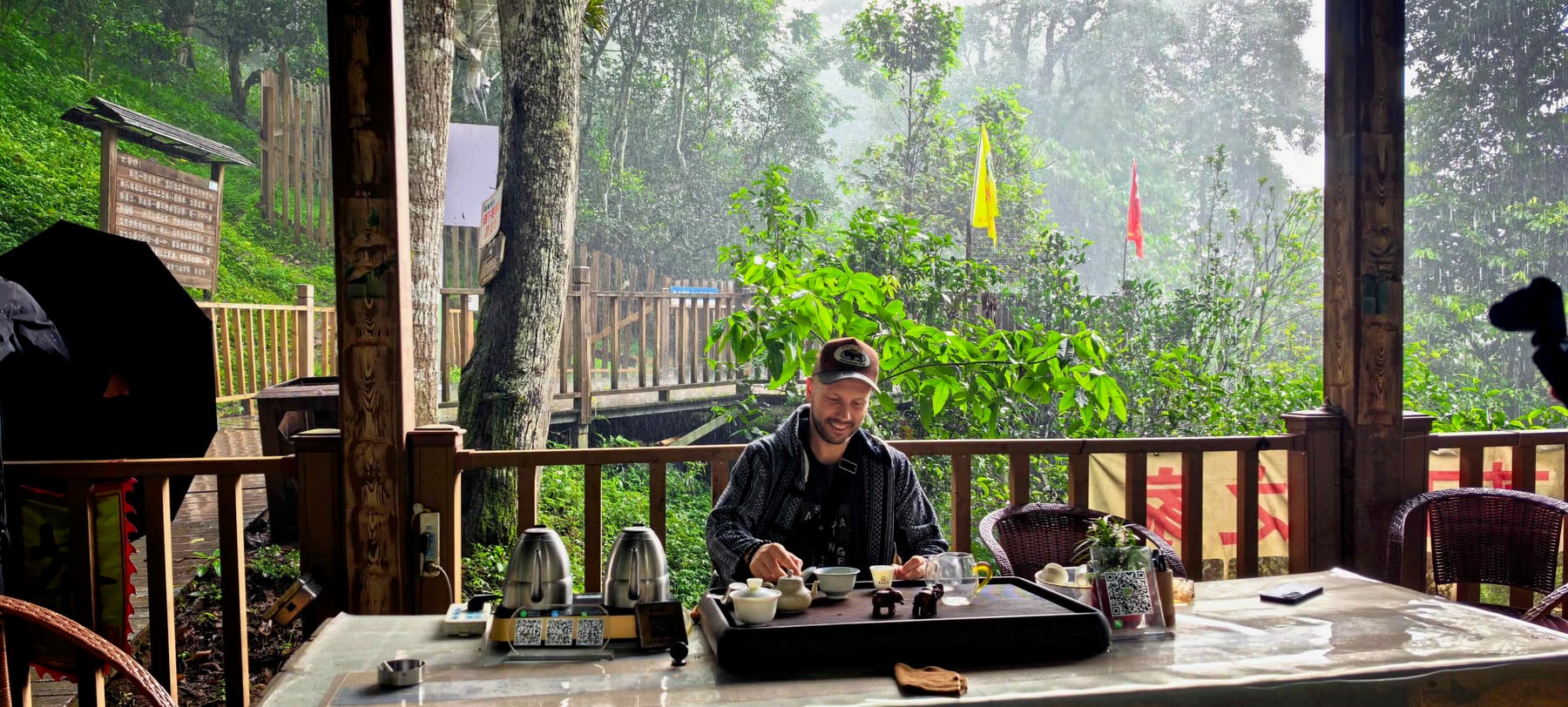
- Jingmai Mountain — the UNESCO tea-forest site on the Myanmar border. Signal is patchy inside the ancient groves themselves but fine at the guesthouses, and the food is worth the trip on its own. For anyone writing, editing, or thinking.
- Chengdu — the urban option. Cafe culture, strong expat and nomad scene, and the full stack of tier-one infrastructure without tier-one prices or tier-one pace. The best base if you need to be in a real city.
Staying longer than 30 days
The simplest play is the border run. Fly out to Bangkok, Singapore, or Hong Kong for two or three days, fly back in, get a fresh 30-day stamp. There’s no cap on the number of entries. Return flights from Kunming or Chengdu to any of those hubs sit in the A$200–400 range for most of the year, sometimes less. People build them into a weekend away rather than treat them as a chore.
One sanity note — remote work is not employment. If you’re planning to stay six months, take on a Chinese client, or teach English, that’s a different visa conversation, and we’d tell you to do it properly.
One of the easier open doors in China this decade
The cost of trying has never been lower. A return flight to Chengdu or Kunming, a stamp, and you’re in — for a long weekend, a month, or the first leg of something longer. The policy is real, the border is calm, and the questions people keep asking are almost always smaller than the stories around them.
If you want help shaping a trip around it — a slower week in Dali, a traverse through western Sichuan, a quiet stretch at Jingmai — start here.
Find more resources at boutiquechina.com.au — or follow along on Instagram @boutiquechinatravel for more on travelling China the right way.