
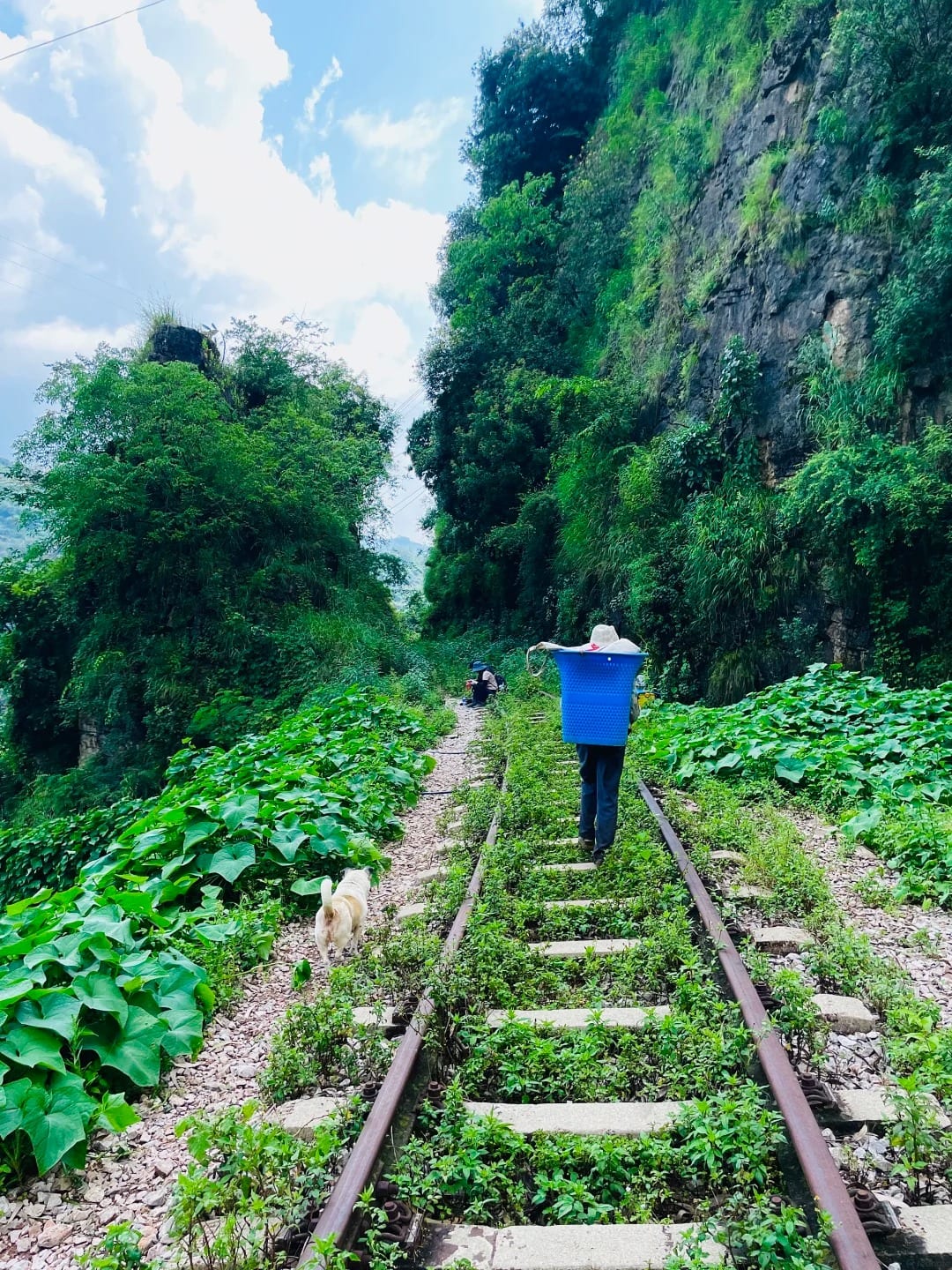
East of Kunming, about an hour and a half by slow train, there’s a railway with grass growing between its sleepers. It’s narrower than any other line you’ll see in China — a metre between the rails — and it runs through stone tunnels and cuttings, past yellow-walled stations, down a river gorge towards the town of Yiliang. No scheduled train has passed this way in years. The French built it in 1910, and Kunming people walk it at weekends.
This is the Yunnan–Vietnam Railway (滇越铁路): the line that once linked Kunming to the sea at Haiphong. Here’s its history, what makes it unlike any other railway in China, and the sections you can still walk, ride and see today — from Kunming’s railway museum to the bridge the French hung over a gorge in Honghe.
When to go: October to April is walking season. The dry months bring clear skies and firm ground, and Kunming’s winter days are mild. From about June to September the rains make the sleepers slippery and the cuttings muddy. Kunming’s railway museum, the best place to start, is closed on Mondays and Tuesdays.
| Where | What you’ll see | Area | Best for |
|---|---|---|---|
| Yunnan Railway Museum | A 1930s Michelin railcar, three gauges side by side | Kunming | Everyone, before the trip |
| Kebao → Yiliang walk | 16 km of track, a dozen-plus tunnels, a French station yard | Yiliang, east of Kunming | Walkers |
| Bisezhai station | The line’s grandest station, customs house, Greek hotel | Mengzi, Honghe | History, photographers |
| Renzi Bridge | A 1908 steel arch over a 100-metre gorge | Pingbian, Honghe | Engineering buffs |
| Kaiyuan & Jianshui trains | Short rides on the old metre gauge | Honghe | Families |
| Hekou | The border bridge to Vietnam | Hekou, Honghe | The end of the line |
A railway built for tin and empire
In 1895 a Sino-French convention gave France the right to run its Vietnamese railways into Yunnan, and the concession followed in 1898. The prize was the province’s minerals, above all the tin of Gejiu, and a back door into Yunnan and Sichuan before the British could reach them from Burma. A French colonial company, the Compagnie française des chemins de fer de l’Indochine et du Yunnan, took the concession. Work on the Chinese side began in 1903–04, and through trains from Haiphong reached Kunming on 1 April 1910.
It was a brutal build. The line climbs from under 100 metres at the border town of Hekou to just over 2,000 metres at Shuitang, east of Kunming, with gradients as steep as 30 in 1,000 and curves as tight as 50 metres. The French counted somewhere between 155 and 172 tunnels on the Yunnan side and about 107 major bridges, plus thousands of culverts. It cost about 165 million francs, roughly double the estimate. The human cost is still argued over: estimates of the dead run from about 12,000 — the figure most Western historians use — to as many as 100,000 in Chinese official accounts, most of them labourers lost to malaria and accidents.
The line that kept China in the war
For three years it mattered more than any railway in China. After Japan took the coast in 1937, this was China’s main overseas supply line, and in 1938 two-thirds of the students and teachers of the wartime National Southwest Associated University came to Kunming on it. In mid-1940, after France fell, French Indochina closed the line under Japanese pressure. That September China blew up the border bridge at Hekou and tore up 177 kilometres of track to stop a Japanese advance. From then on, Kunming’s lifeline was the Burma Road, and then the airlift over the Hump.
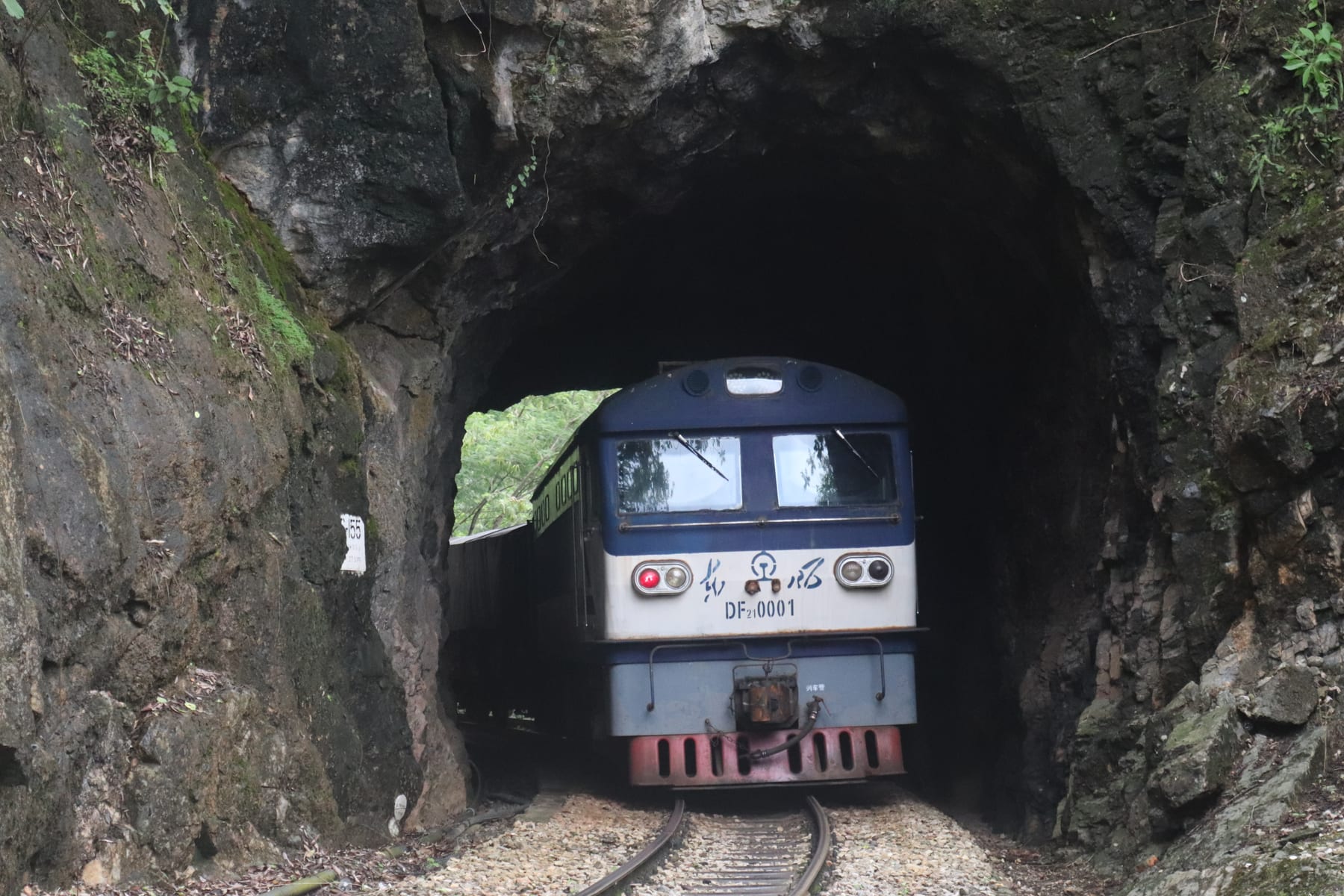
The line was rebuilt by 1957 and renamed the Kunming–Hekou railway. International trains to Hanoi ran again from 1997 to 2002, and regular passenger trains on the Chinese side stopped in 2003. Freight still runs in the south, between Kaiyuan and Hekou. North of there, around Yiliang, the last freight trains stopped in 2019.
Why it’s unlike any other railway in China
- The gauge. China’s railways are standard gauge, 1,435 mm. This one is metre gauge, chosen for the mountains, and it’s now China’s longest surviving metre-gauge line. Locals call it 米轨, “metre track”.
- The architecture. The French built their stations in their own style: yellow walls, louvred shutters, tiled roofs. Bisezhai’s station clock came from Paris. The best survive at Bisezhai and Yiliang.
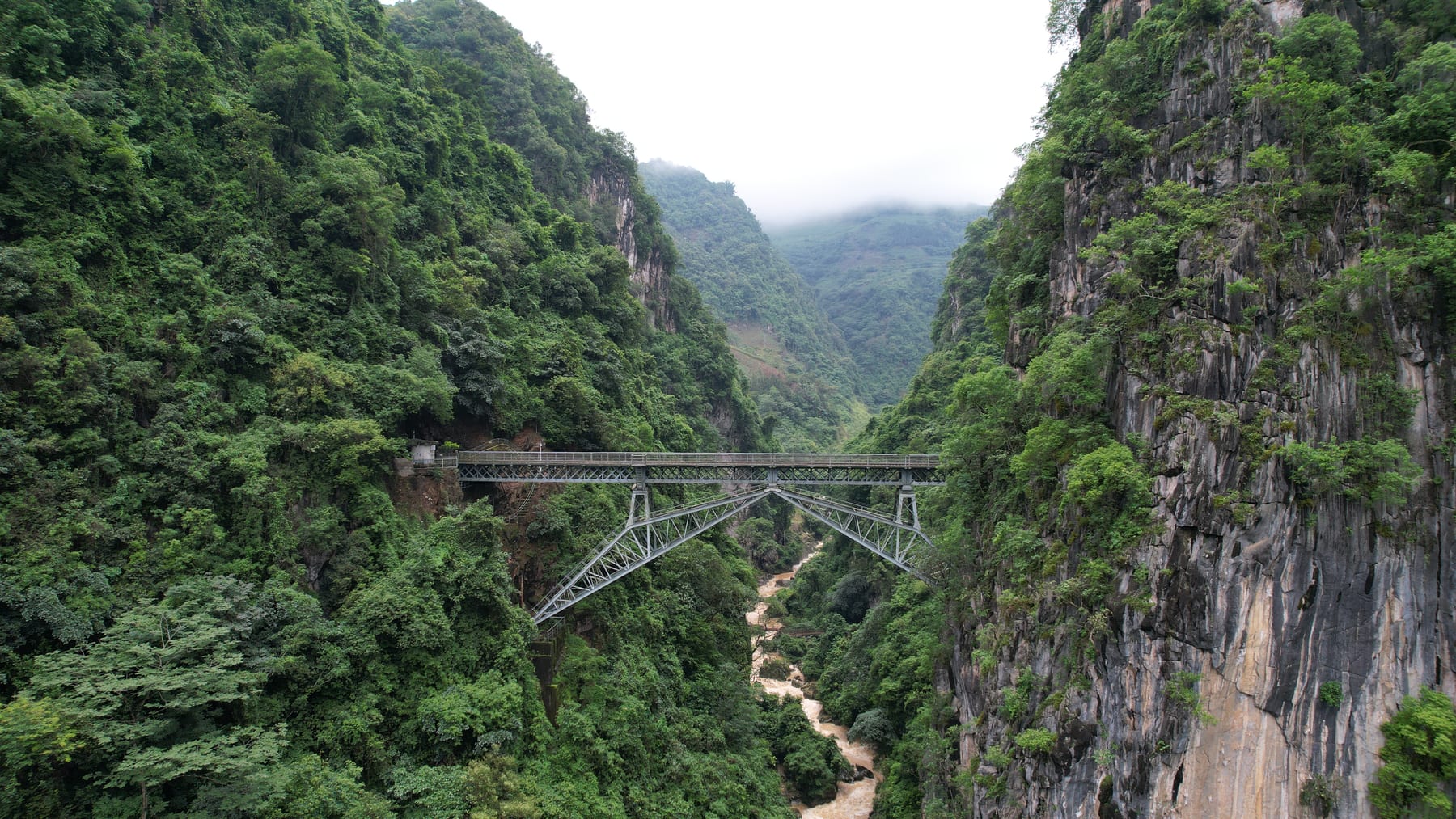
- The engineering. The line was cut through limestone gorges by hand. Its showpiece, the Renzi Bridge, was assembled from parts made in France, none heavier than 100 kg, so they could be carried into the gorge.
Where to walk and see it today
Kunming: the Yunnan Railway Museum (云南铁路博物馆)
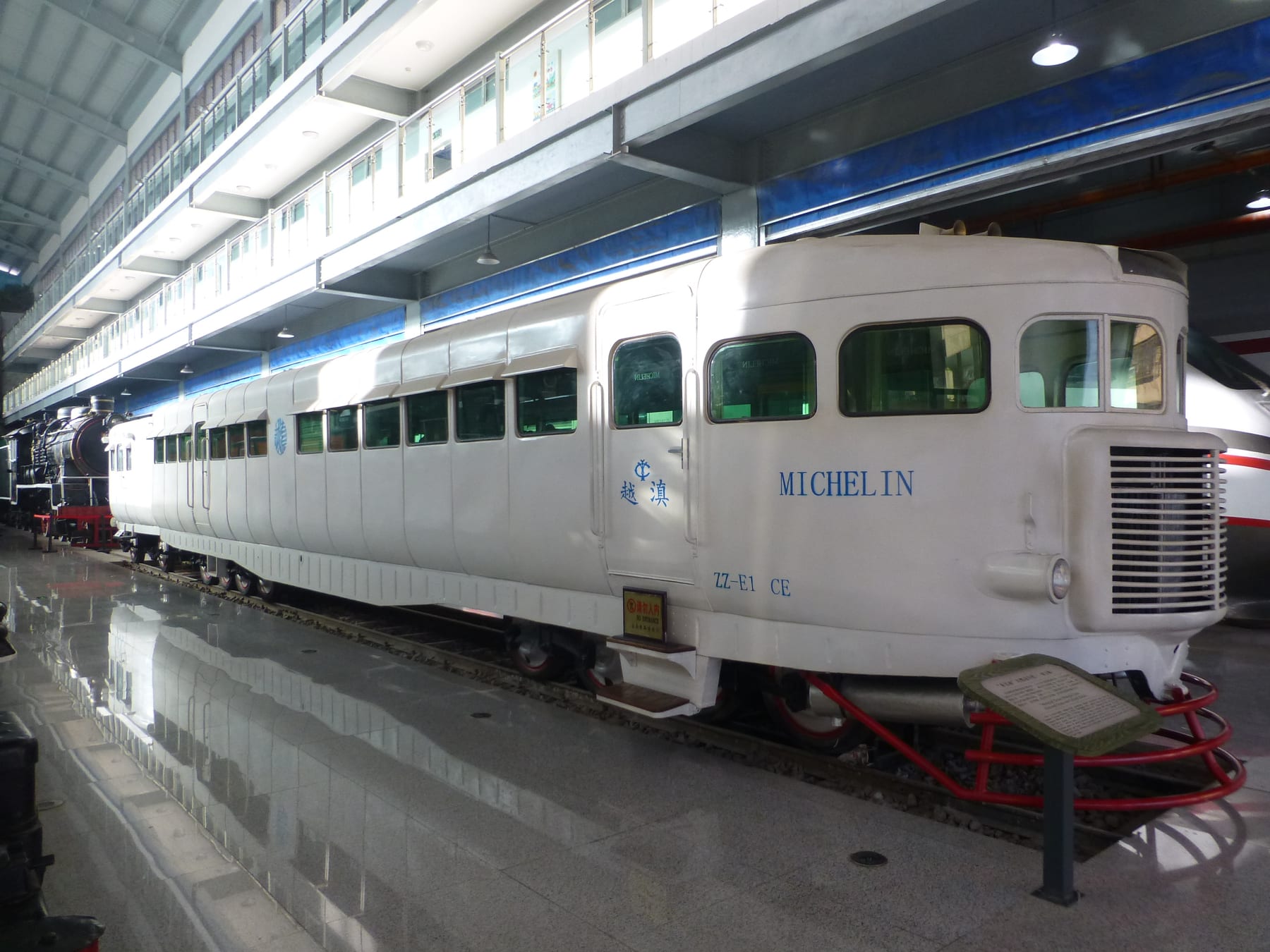
Start at Kunming North Station, where the museum’s south hall copies the line’s original French terminus. Inside are three gauges laid side by side, a walk-on model of the Renzi Bridge, and the museum’s prize: a white Michelin railcar on rubber tyres, which ran the Hanoi–Kunming express in the 1930s and is now a national first-grade relic. Entry has been free since October 2022. It’s open Wednesday to Sunday, 9 am to 5 pm (last entry at 4). In the evenings the old carriages next door become the Locomotive Night Market, serving food.
One thing to know: the photogenic metre-gauge street at Mayuan, in Kunming’s west, belongs to a different line (the old Yunnan–Burma railway). The Yunnan–Vietnam line runs east.
Kebao to Yiliang: the walk (可保村 → 水晶坡 → 宜良)
This is the stretch to walk. In 2024 Yunnan’s sports bureau named it one of the province’s classic hiking routes: about 16 kilometres of track from Kebao village through Shuijingpo to Yiliang station. The line follows the gorge of the Tangchi River — the outflow of Yangzonghai lake — dropping from one basin to the next, so it’s almost level but always gently downhill.
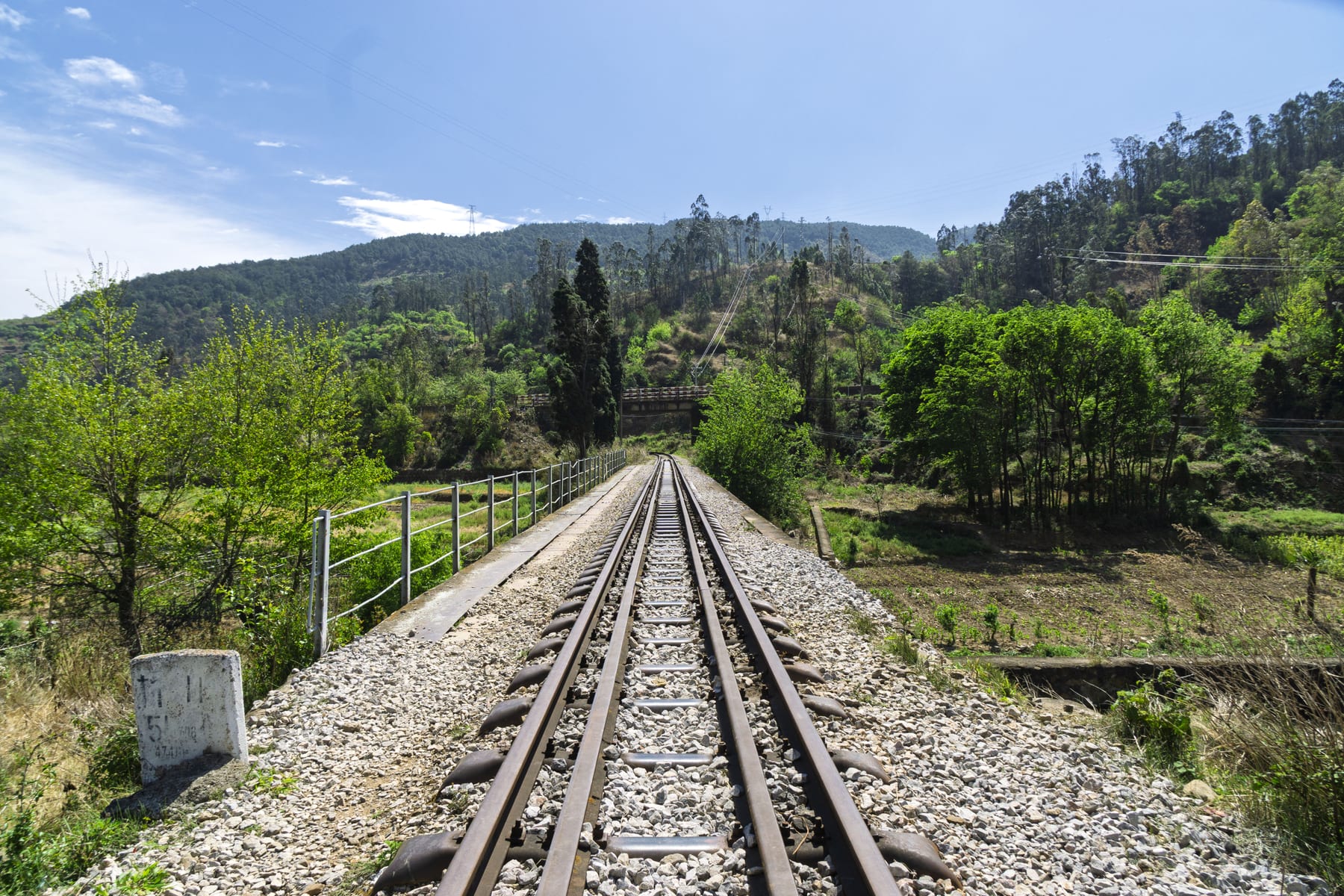
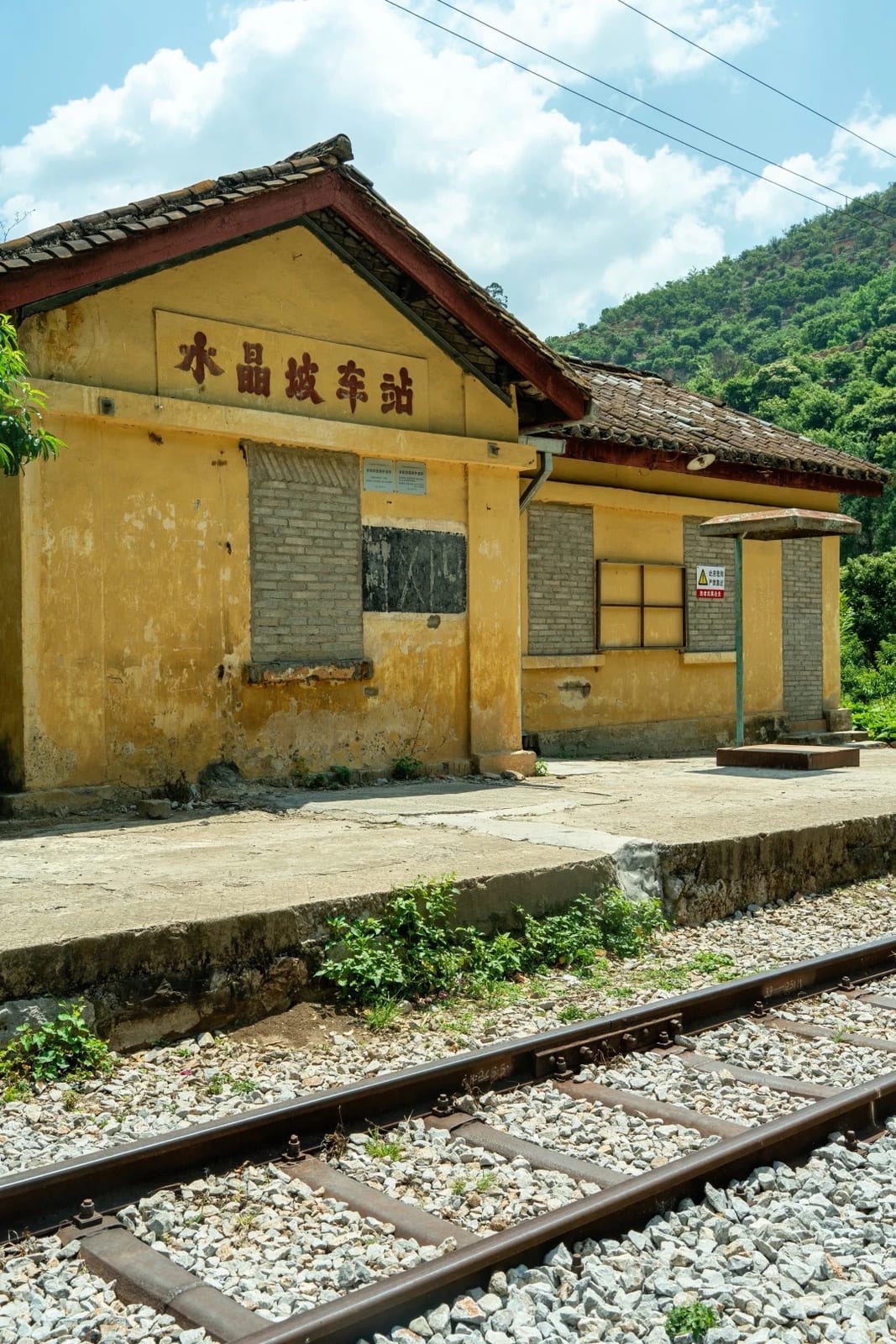
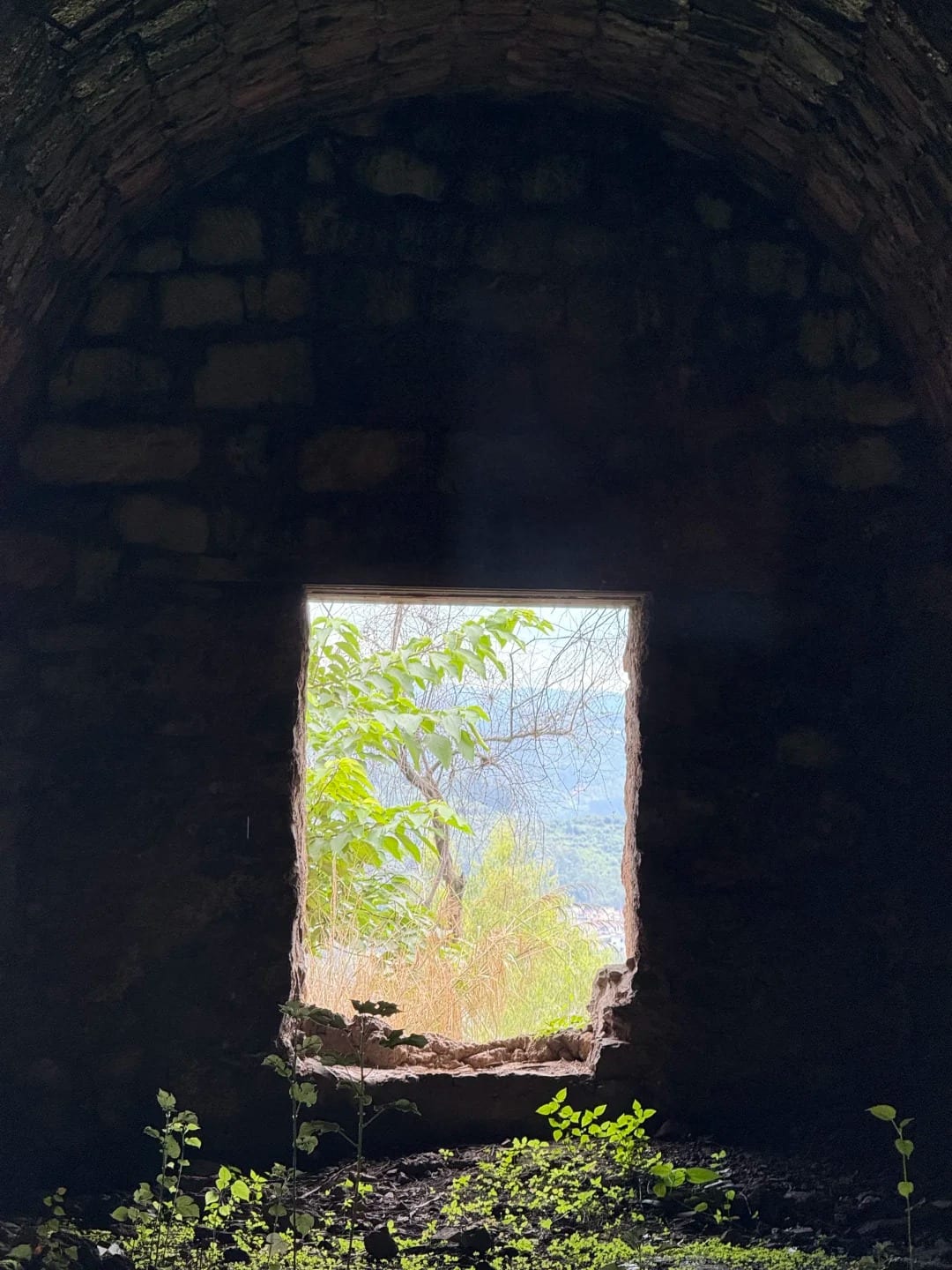
Along the way are more than a dozen tunnels. The longest is a 358-metre rock gallery, built in 1958; elsewhere, open galleries with arched sides let daylight fall across the track. There are stone-arch bridges over the river, limestone cliffs and caves above the valley, and halfway along, the yellow station house at Shuijingpo, built in 1979 and closed in 2015, its name still on the wall.
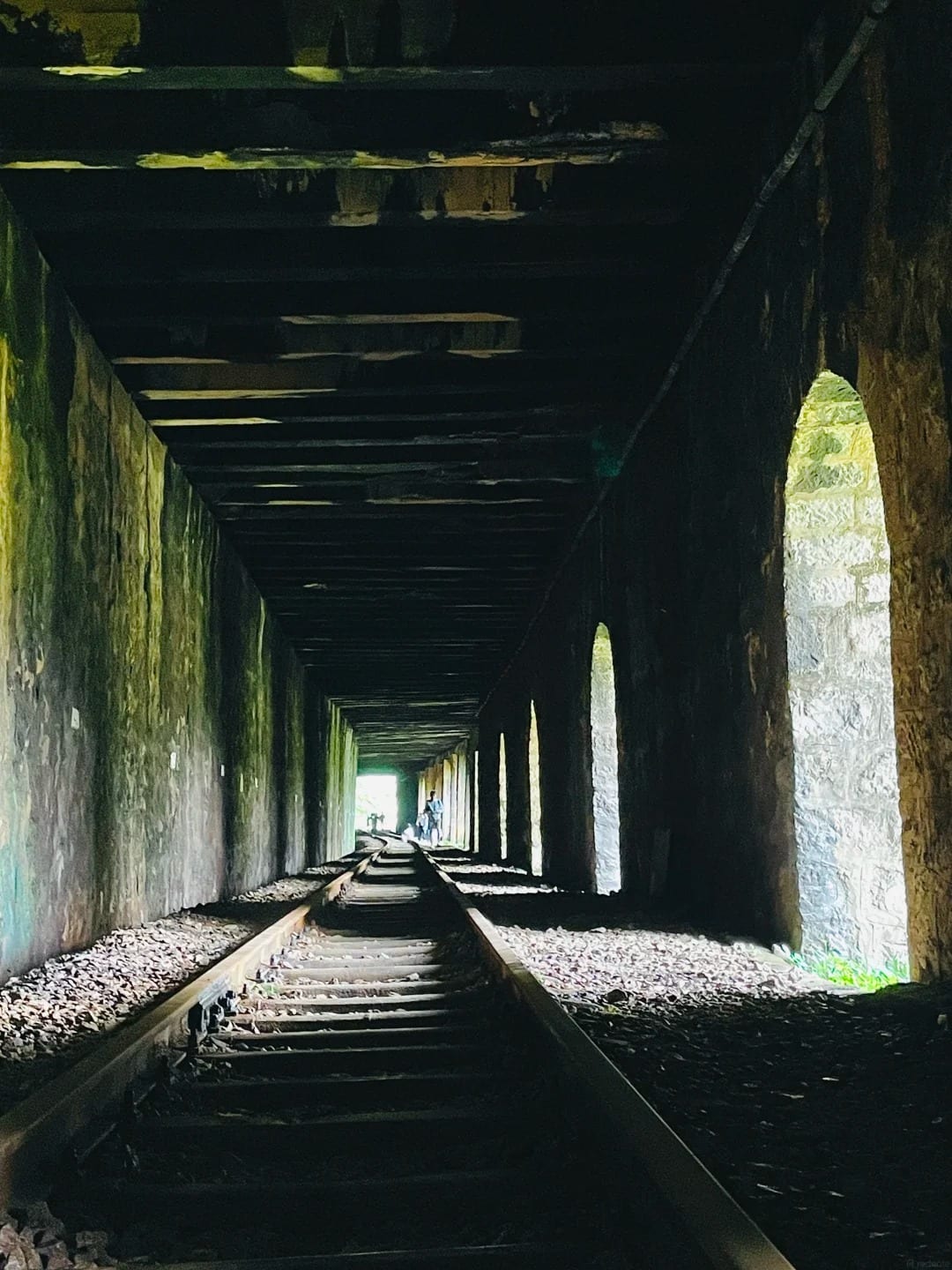
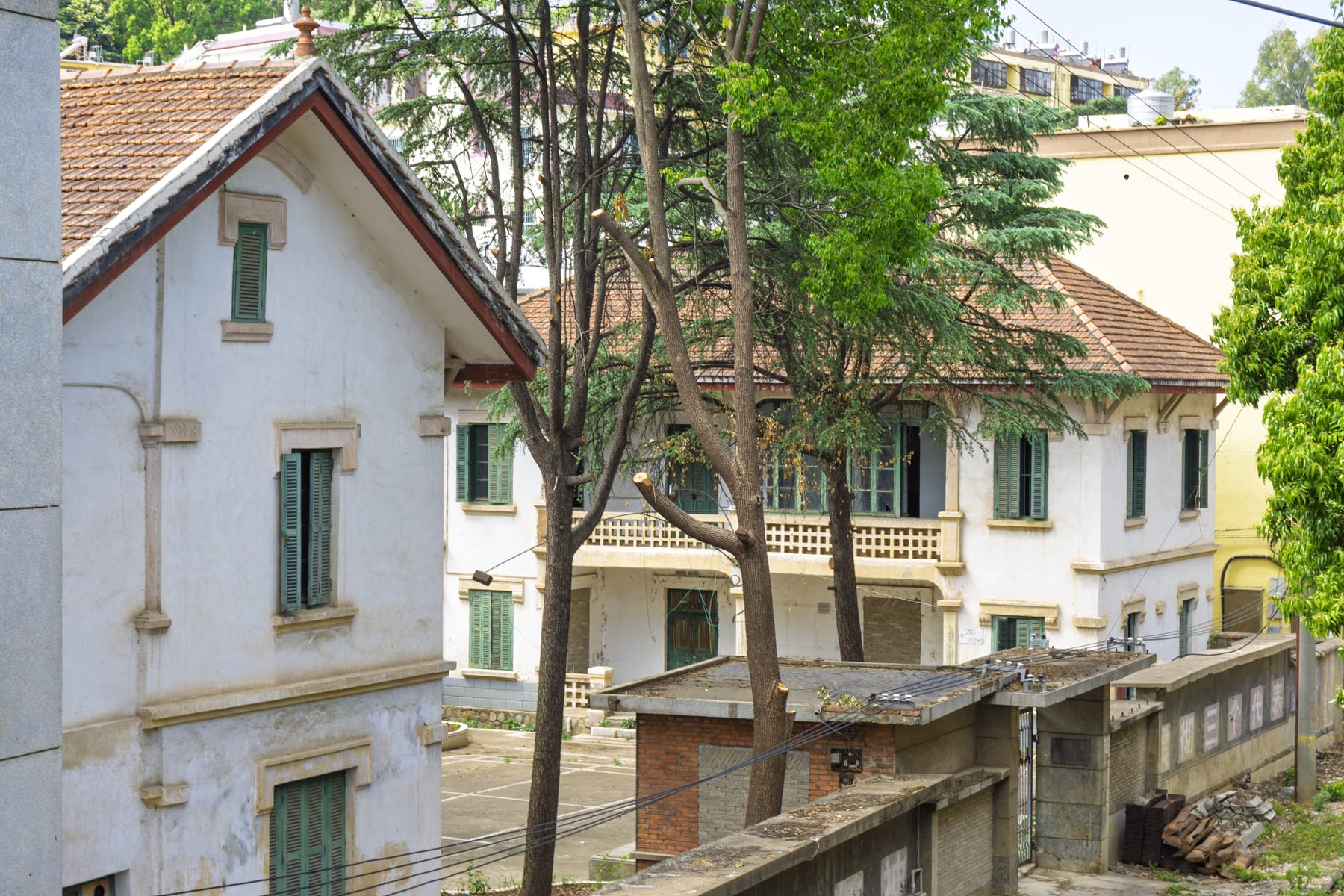
The walk ends at Yiliang, where about 18 French-era railway buildings survive around the station: offices, staff houses, a water tower and the old engine shed, with yellow and white walls and green shutters. Then lunch. Yiliang roast duck is the county’s pride: local ma ducks, glazed with honey and roasted in a closed oven over burning pine needles, a technique on Yunnan’s provincial intangible heritage list since 2009.
To get there, take the 7:45 slow train from Kunming Station to Yongfengying, on the Nanning–Kunming line, and walk across to Kebao. That’s how our two-day small-group departure does it, with a guide, head torches and the bags sent ahead by road.
Bisezhai station, Mengzi (碧色寨)
If Yiliang is the line’s quiet country end, Bisezhai was its boomtown. Opened in 1909, it was the line’s only special-class station — grander than Kunming’s — because it was where Gejiu’s tin came down to the railway, by way of a 600 mm branch line built by Chinese merchants. Traders from 13 countries worked here, and it was nicknamed the “Little Paris of the East”. Eleven of its buildings are now national heritage: the station, a Mengzi Customs branch office, a Mobil kerosene warehouse and the Greek-run Hotel Kolous among them. Feng Xiaogang filmed the field-hospital scenes of his 2017 film Youth (芳华) here.
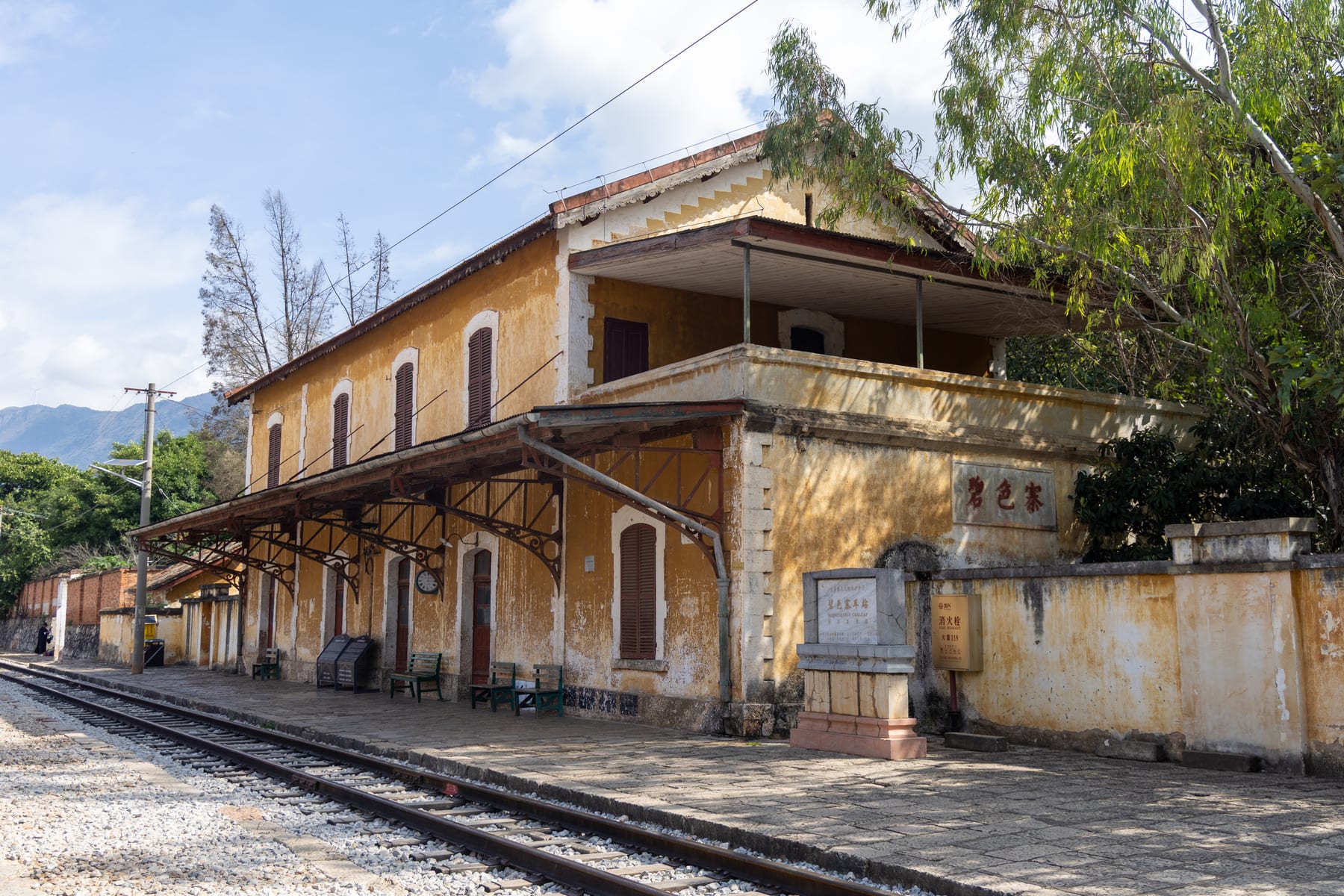
Entry is free. Cars can’t drive in during the day, so you park at the visitor centre and take the shuttle bus.
The Renzi Bridge, Pingbian (人字桥)
Deep in the gorges of Pingbian county, the line crosses a 102-metre drop on a single steel arch shaped like the character 人, “person”. The French engineer Paul Bodin designed it, and it was built between March 1907 and December 1908, from pieces carried in by hand. More than 800 workers died on it. When China blew up the line’s southern bridges in 1940, this was the one it spared. It’s a national heritage site, it still carries freight trains, and there’s a viewing path in the gorge below. See it from the path, never from the deck.
Riding the metre gauge: Kaiyuan and Jianshui
There’s one passenger train left on the original line: the Kaiyuan sightseeing train, an 11.6-kilometre run from Kaiyuan to Data, a few times a day. For a longer ride, the Jianshui small train runs 13 kilometres from Jianshui to Tuanshan village, past the Double Dragon Bridge. That track is the Yunnan–Vietnam line’s Chinese-built cousin, the Gejiu–Bisezhai–Shiping railway, which local tin merchants built between 1915 and 1936 to keep the French out. It was converted to metre gauge in 1970.
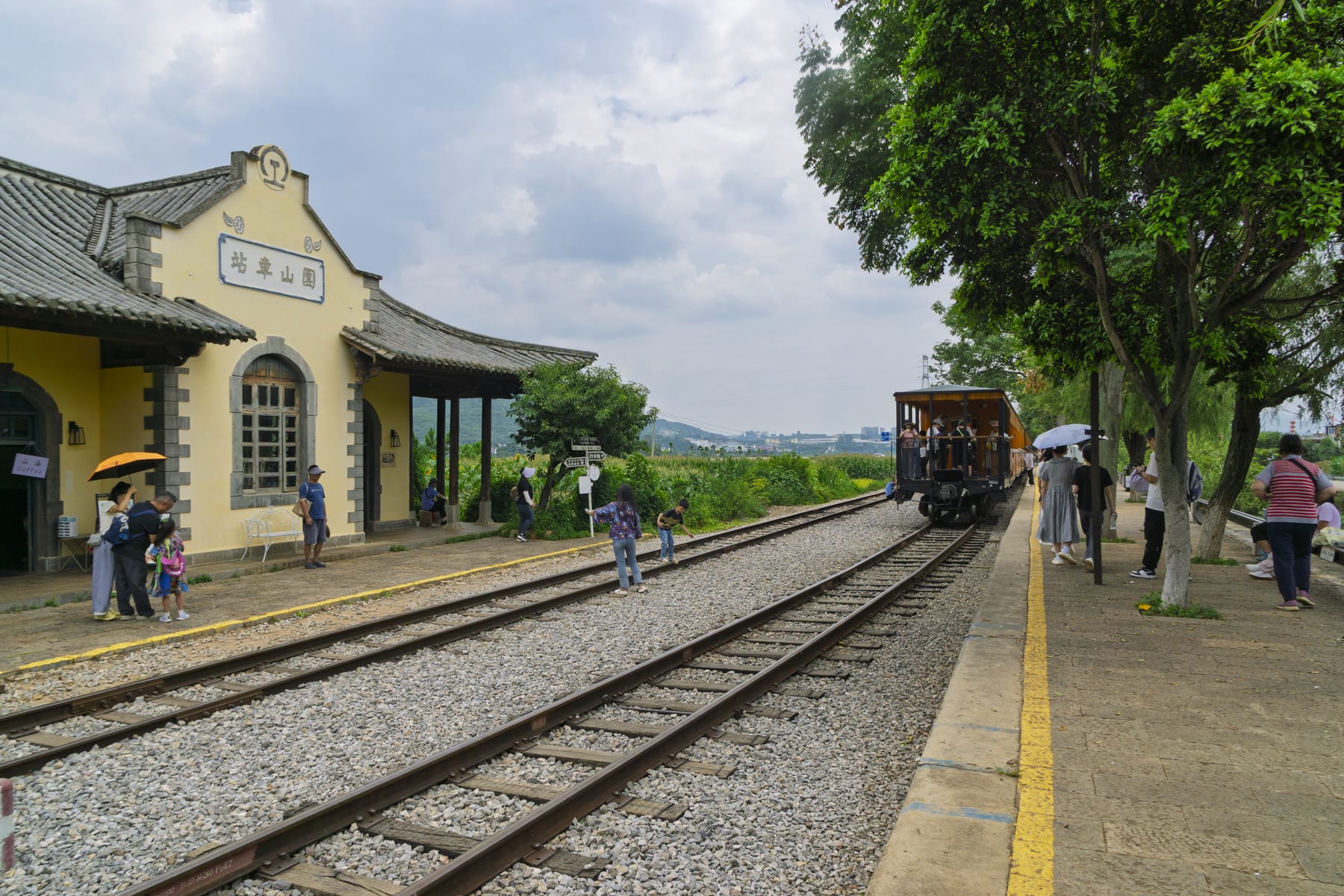
Jianshui is worth a night in its own right. We stay at Hanlinyuan Courtyard, inside the old town, and the town is the first stop on our Hani Rice Terraces tour with Little Chinese Everywhere, on the way to Yuanyang.
Hekou: the end of the line
At Hekou the line crosses a 100-metre bridge over the Nanxi River, where it meets the Red River, into Lao Cai, Vietnam. The border runs through the middle of the bridge. It carries metre-gauge freight only; people cross on foot at the road border nearby. On the Vietnamese side the old line is still a passenger railway, with trains to Hanoi every day.
Before you walk
- Go with someone who knows the line. The Yiliang stretch has had no scheduled trains since 2019, but it’s still railway property. The province promotes it as a hiking route and holds races on it, but walking on railway lines is otherwise prohibited in China, so don’t improvise it elsewhere. Never walk onto a line that still carries freight, like the Renzi Bridge.
- Footwear. It’s nearly flat, but every step is on sleepers or loose ballast. Walking boots with ankle support make a real difference over 16 kilometres.
- Tunnels. The longer ones are dark in the middle. Bring a head torch.
- Supplies. There’s nothing to buy along the line. Carry water and snacks.
- Apps and entry. Check China’s visa-free entry rules and set up your China travel apps before you fly — train tickets and museum bookings all run through your phone.
So which part should you see?
- One day from Kunming: walk Kebao to Yiliang, then eat the duck. It’s the most of the old line you’ll get in a single day, and the most fun.
- Only a few hours in Kunming: the railway museum, then the night market next door.
- History and architecture: Bisezhai, combined with Jianshui and the Yuanyang rice terraces on a southern Yunnan trip.
- Engineering: the Renzi Bridge, from the path below.
- With children: the Jianshui small train.
Our two-day Yunnan–Vietnam Railway & Fuxian Lake departure takes the slow train out of Kunming, walks the old line to Yiliang for roast duck, and spends the night on Fuxian Lake, Yunnan’s deepest. It runs any day you choose, for two to eight guests, with a guide. Arriving early? Here’s where Kunming locals spend their weekends. Or tell us your dates and we’ll build the railway into a private Yunnan trip.
Photos: walking the track, the arched gallery, Shuijingpo station and the tunnel window are Boutique China’s own. Via Wikimedia Commons: freight train near Wantang and the Renzi Bridge by Liuxingy, CC BY-SA 4.0; the Michelin railcar by Vmenkov, CC BY-SA 3.0; the Tangchi River bridge, Yiliang station and the Jianshui small train by Kcx36, CC BY-SA 4.0; Bisezhai station by 瑞丽江的河水, CC BY-SA 4.0.