

Most travellers treat Kunming as an airport. They land, sleep, and catch the first train to Dali. Kunming people would tell you that’s a mistake. At 1,890 metres, with spring-like weather most of the year, this is a city that lives outdoors: ballroom dancing by Green Lake at nine in the morning, Sunday hikes in the Western Hills, whole families out on the dam to watch the gulls and the sunset.
Here are the seven places we’d send you in Kunming — the parks, temples and lakeshore that locals actually use. It’s how we’d spend a day or two in the city before heading out into Yunnan.
When to go: Kunming works year-round, but the dry season, roughly November to April, is when the city is at its best. That’s gull season — black-headed gulls winter here from mid-October to March — and it’s also camellia season at the Golden Temple (January to March) and cherry blossom on Yuantong Hill (March). Summer is the rainy season, and the lotus ponds at Green Lake and Daguan Park are in flower.
| Place | What it is | Best time | Getting there |
|---|---|---|---|
| Green Lake 翠湖 | The city’s living room | Winter mornings | Metro Line 5, Huashan West Road |
| Yuantong Temple 圆通寺 | A 1,200-year-old temple in a hollow | Early morning | Metro Line 5, Yuantong Hill |
| Golden Temple 金殿 | A bronze hall and a camellia garden | January–March | North-east edge of the city |
| Western Hills 西山 | Cliff path 414 m above the lake | Clear weekday mornings | Metro Line 3, Western Hills Park |
| Daguan Pavilion 大观楼 | Tower, lotus ponds, the long couplet | Lotus season, July–September | Bus or taxi |
| Haigeng Dam 海埂大坝 | Gulls and sunset on Dianchi | November–March | Metro Line 5, Daba |
| Haiyan Village 海晏村 | Old fishing village, east shore | Weekday afternoons | Taxi |
In the old city, on foot
Green Lake (翠湖)
If Kunming has a centre, it’s here: 15 hectares of water inside a park, ringed by willows, free since 2002 and open from six in the morning. Come early. Retirees run through tai chi and sword routines, couples ballroom-dance on the paths, and somewhere there’s always a pipa playing. From November the gulls arrive, and the causeways fill with people feeding them. There’s a statue here of Wu Qingheng, the retiree who fed the gulls every day, and Kunming loves him for it.
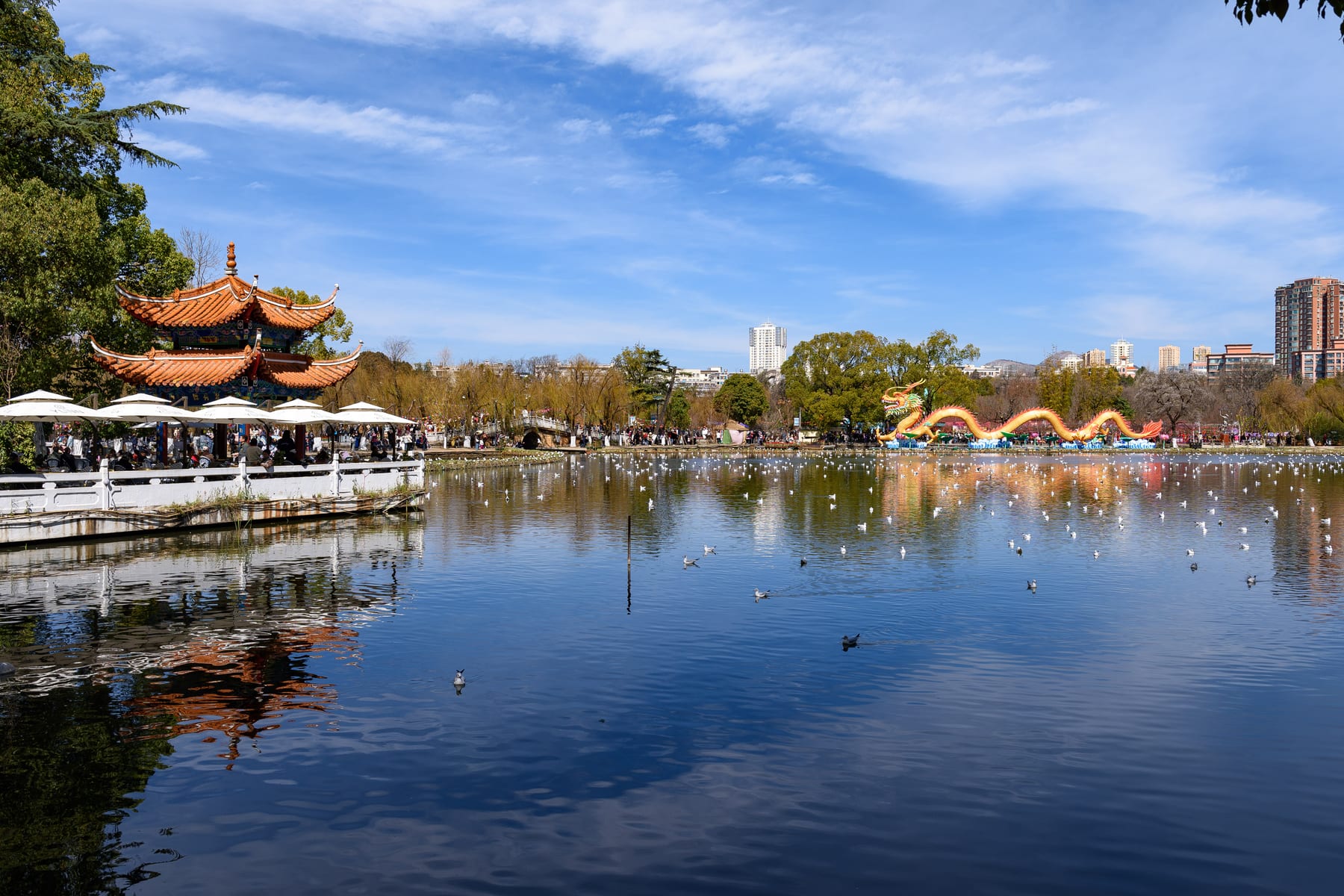
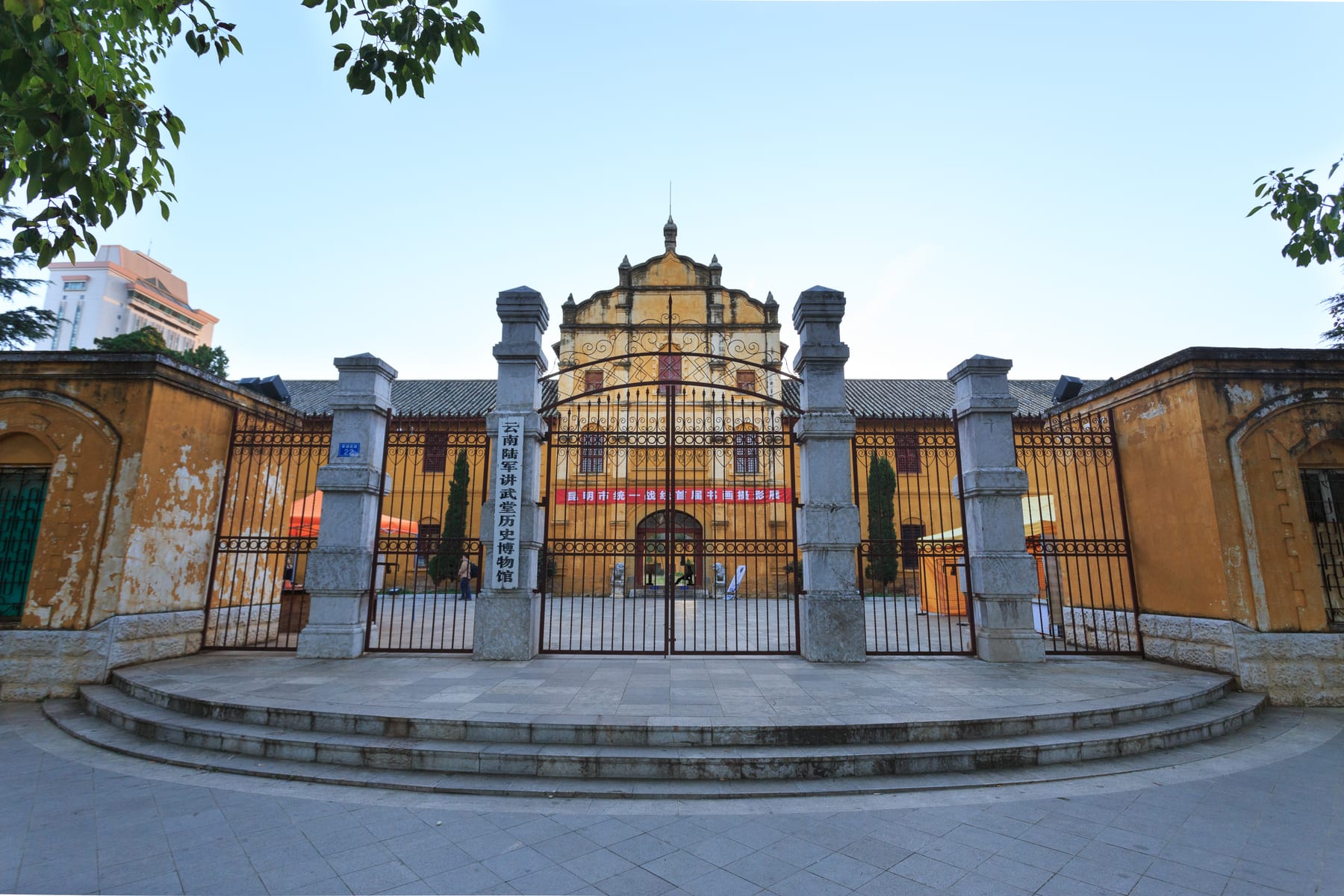
Walk the two old causeways across the lake. On the west shore is the Yunnan Military Academy (云南陆军讲武堂), opened in 1909, a yellow courtyard building where Zhu De and Ye Jianying, later marshals of the People’s Liberation Army, were trained. It’s a museum now, closed on Mondays. Yunnan University sits on the north side, and the lanes behind it, Wenlin Street and Wenhua Lane, are where students and everyone else go for coffee and noodles.
Yuantong Temple (圆通寺)
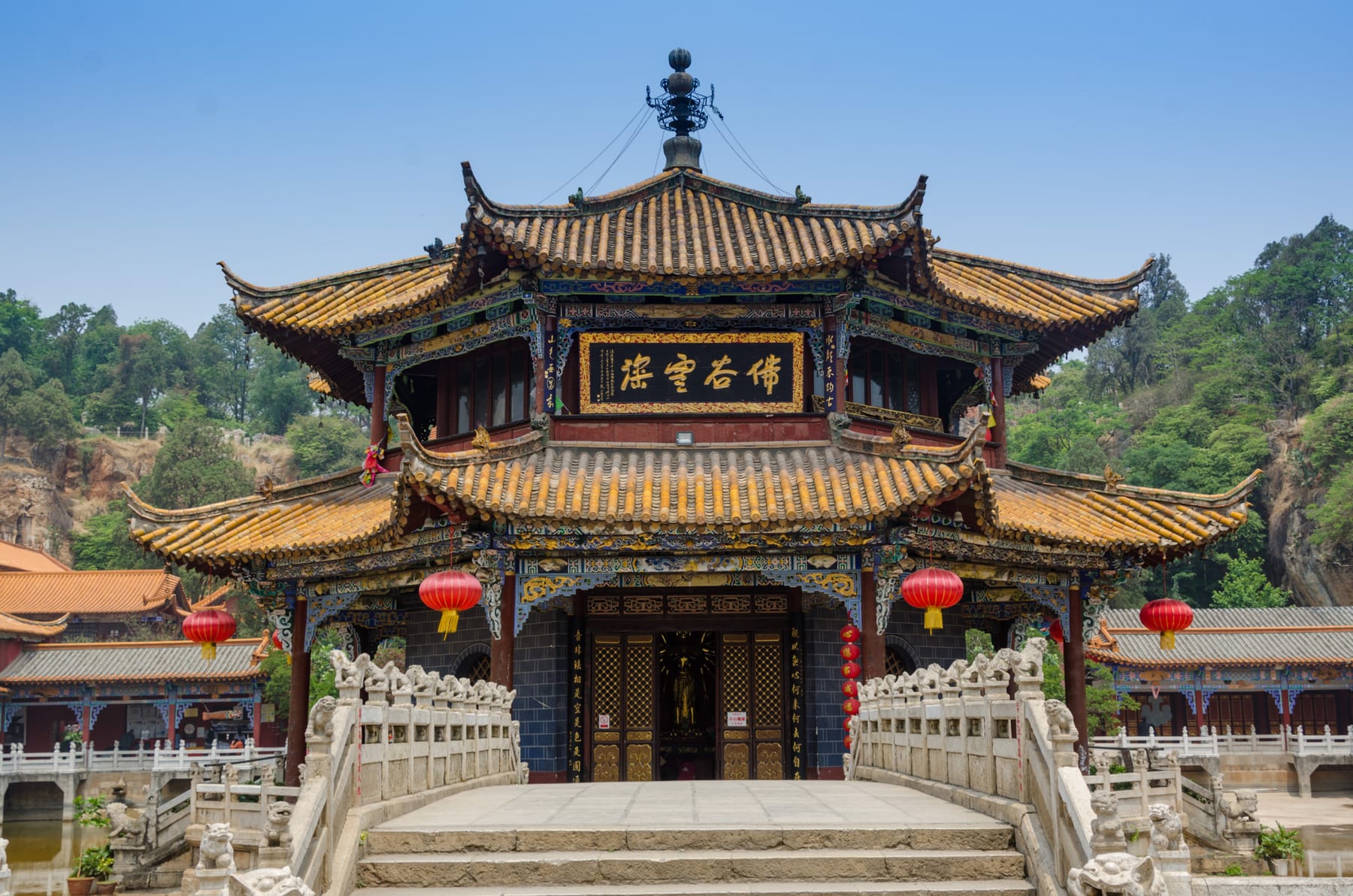
About a kilometre east of Green Lake, Yuantong is one of Kunming’s oldest temples. It was founded in 765, when the Nanzhao kingdom built the first town here, and rebuilt and renamed in the Yuan dynasty from 1301. What makes it unusual is the layout: the temple sits in a natural hollow, so you walk down from the gate into it. At the centre is a pond with an octagonal pavilion on bridges, wrapped in galleries. Behind the main hall is a Thai-style hall with a bronze Buddha given by Thailand. Entry costs a few yuan, and it’s busiest on the 1st and 15th of the lunar month.
Climb Yuantong Hill behind it in March, when the cherry and crab-apple blossom draws half the city — the “Yuantong flower tide” is on Yunnan’s intangible heritage list.
Up in the hills
The Golden Temple (金殿)
On a pine-covered hill at the north-eastern edge of the city stands China’s largest surviving bronze building. The first bronze hall here went up in 1602, and in 1637 it was taken apart and carried off to Jizu Mountain. The one you see is a new casting from 1671, paid for by the general Wu Sangui — his name is cast into the roof beam. It’s 6.7 metres high, every column, bracket and roof tile in bronze, more than 200 tonnes of it.
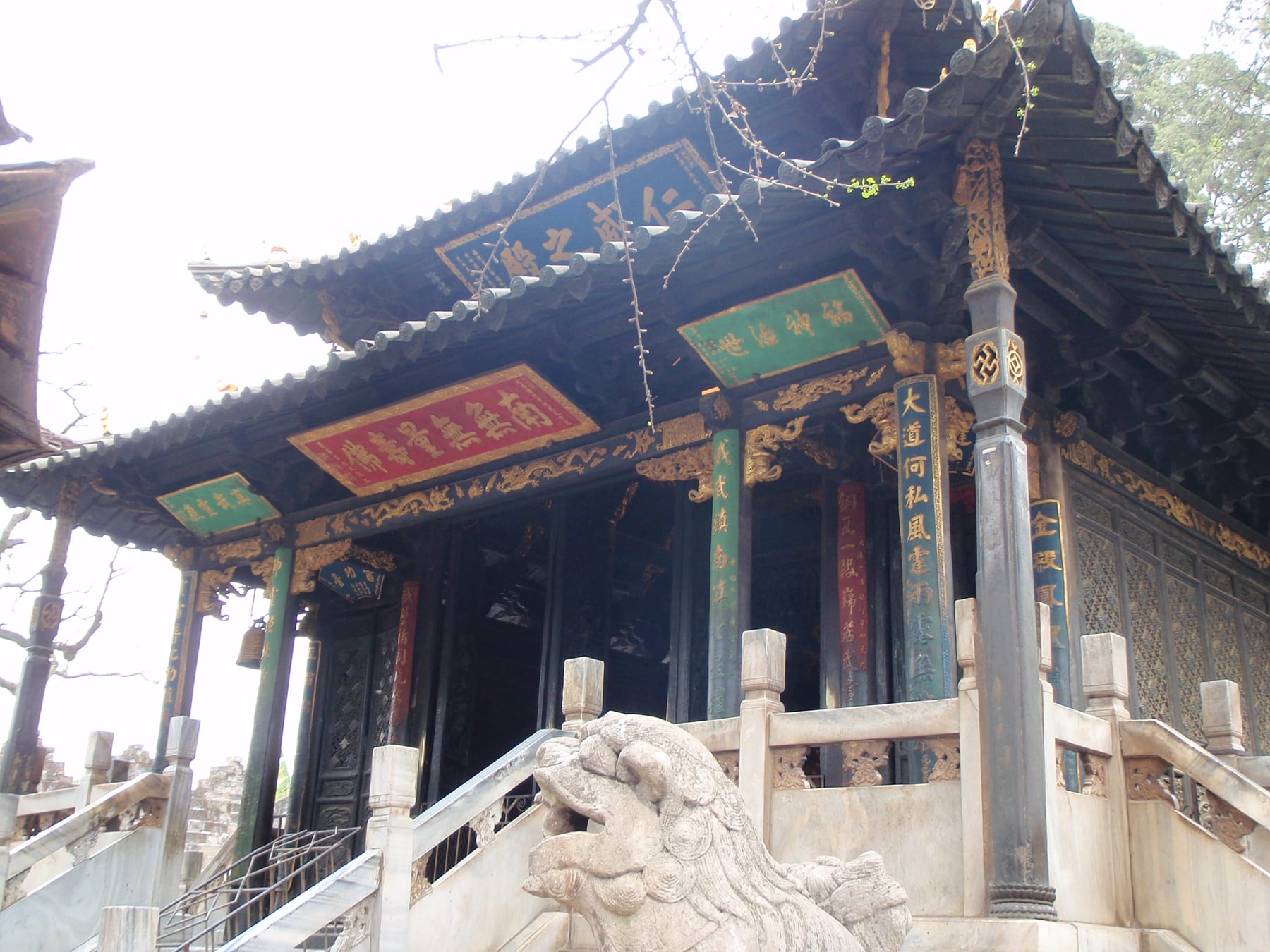
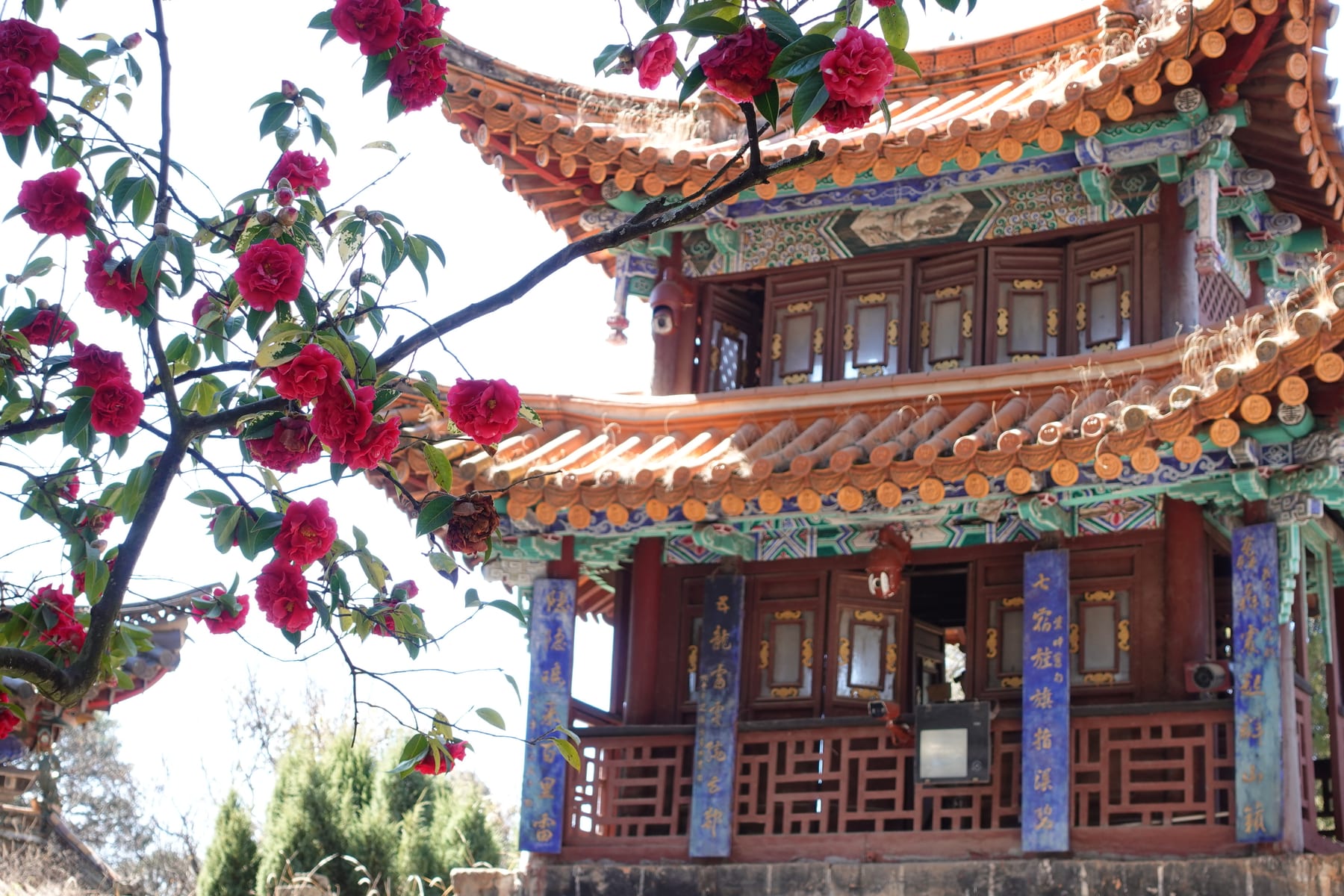
The other reason to come is the camellia garden, around the temple: some 400,000 plants of nearly 1,200 varieties, peaking from January to March and certified by the International Camellia Society as a garden of excellence. On the ninth day of Chinese New Year the temple holds its fair, with snacks, lanterns and lion dancing — fun, but packed.
The Western Hills & the Dragon Gate (西山龙门)
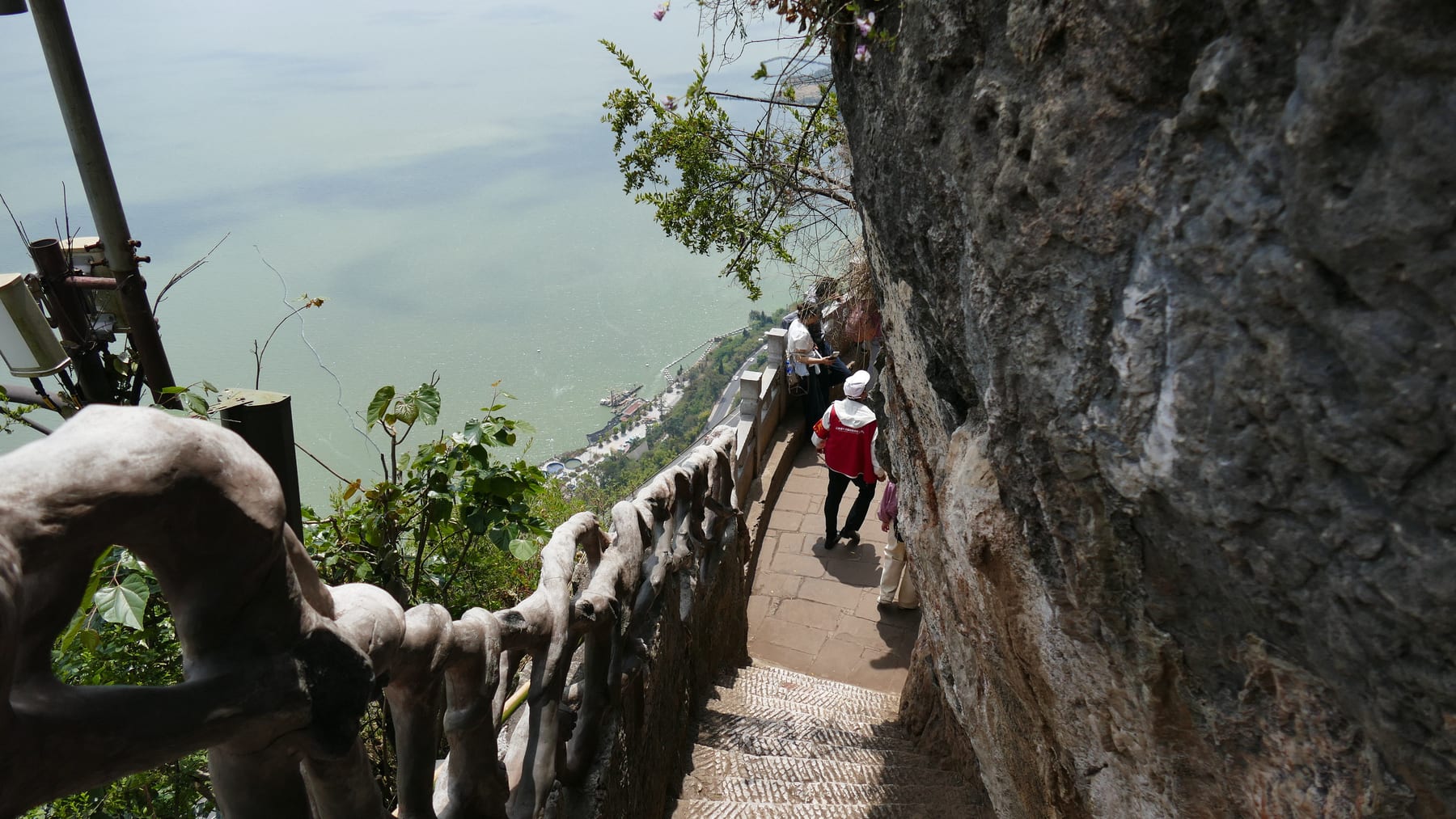
Look west across Dianchi from anywhere on the east shore and the ridge of the Western Hills looks like a woman lying on her back, her hair trailing into the lake. Kunming calls it the Sleeping Beauty (睡美人). Climb it and you reach the Dragon Gate: a path, tunnels and grottoes cut by hand into the cliff, mostly by Taoist monks and their patrons in the Qing dynasty, with a stone gate 414 metres above the water. It’s the best view in Kunming, and the narrow path is the point.
On the way up are three old temples and one modern pilgrimage. Huating Temple (华亭寺), free since 2017, and Taihua Temple (太华寺) are both known for their camellias. Sanqing Pavilion (三清阁) is a Taoist complex climbing the cliff. And Nie Er’s tomb belongs to the composer of China’s national anthem. The tomb is laid out in the shape of a moon lute.
Take Metro Line 3 to its last stop, Western Hills Park, then the shuttle bus up the mountain. Or come across the lake on the Dianchi cable car from the Haigeng side. A new gondola is being built to replace the old Dragon Gate chairlift, so expect some works on the upper slope. Go on a weekday; weekend queues for the buses are long.
Down by the lake
Daguan Pavilion (大观楼)
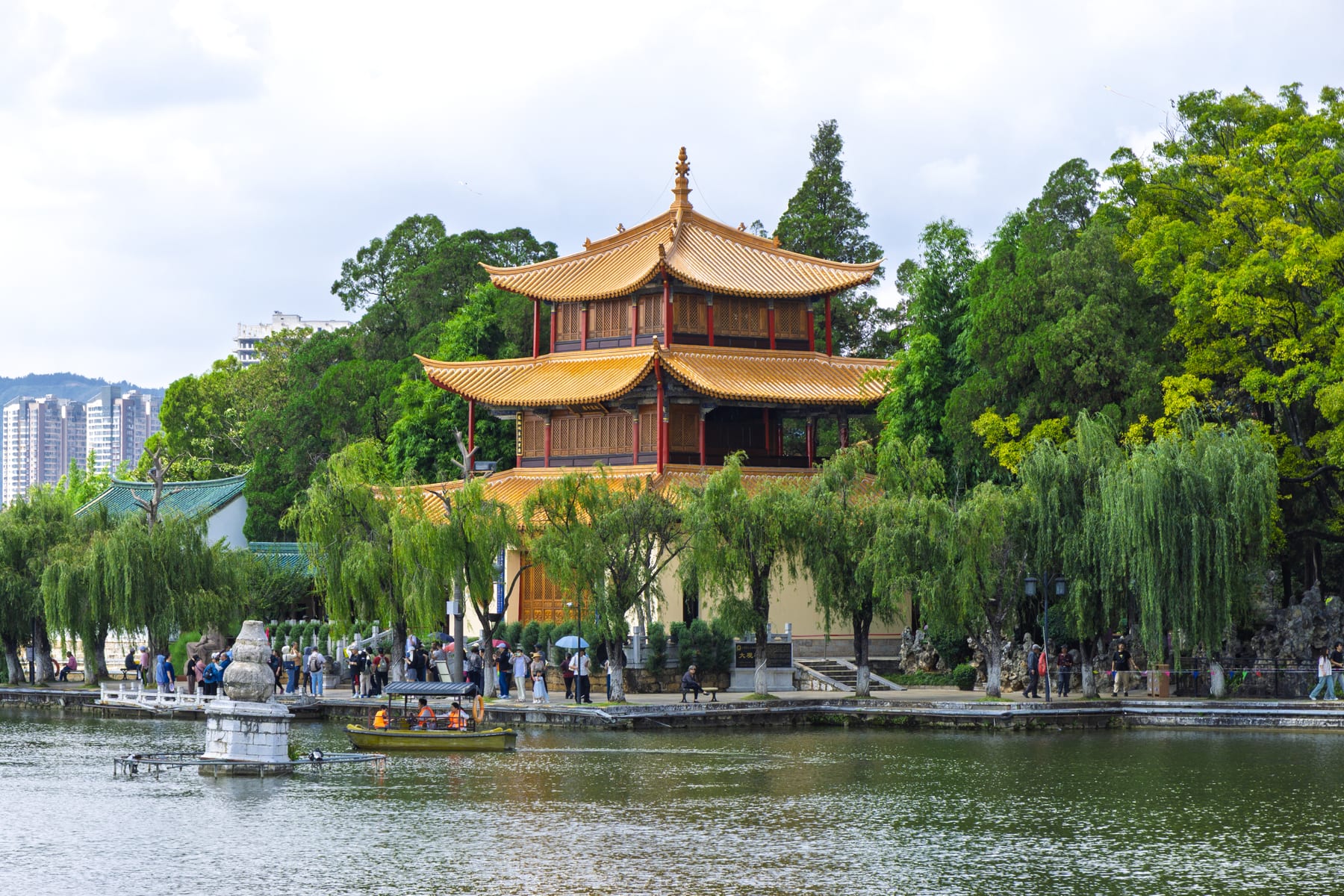
On Dianchi’s northern shore, Daguan Park is free and full of locals strolling and out in paddle boats. The three-storey tower was first built in the 1690s, and the present one dates from 1883. It’s famous for one thing: the long couplet hung at its gate, 180 characters by the Qing scholar Sun Ran. The first half describes the lake in front of you, the second runs through 2,000 years of Yunnan’s history. Chinese visitors call it the longest couplet under heaven. From July to September the lotus ponds are in flower; in winter the gulls work along the river.
Haigeng Dam (海埂大坝)
This is where Kunming comes to watch the gulls. The dam is a 2.4-kilometre embankment along the lake, built in the late 1960s and rebuilt in 2017, free and open all day. Black-headed gulls first wintered in Kunming in 1985, and about 40,000 now come every year, from breeding grounds in Mongolia, around Lake Baikal and in the Russian Far East. Go in the morning for the gulls, or late afternoon for the sunset behind the Western Hills — around half past six in midwinter, after seven by March. Only feed them the gull food sold at the official stalls.
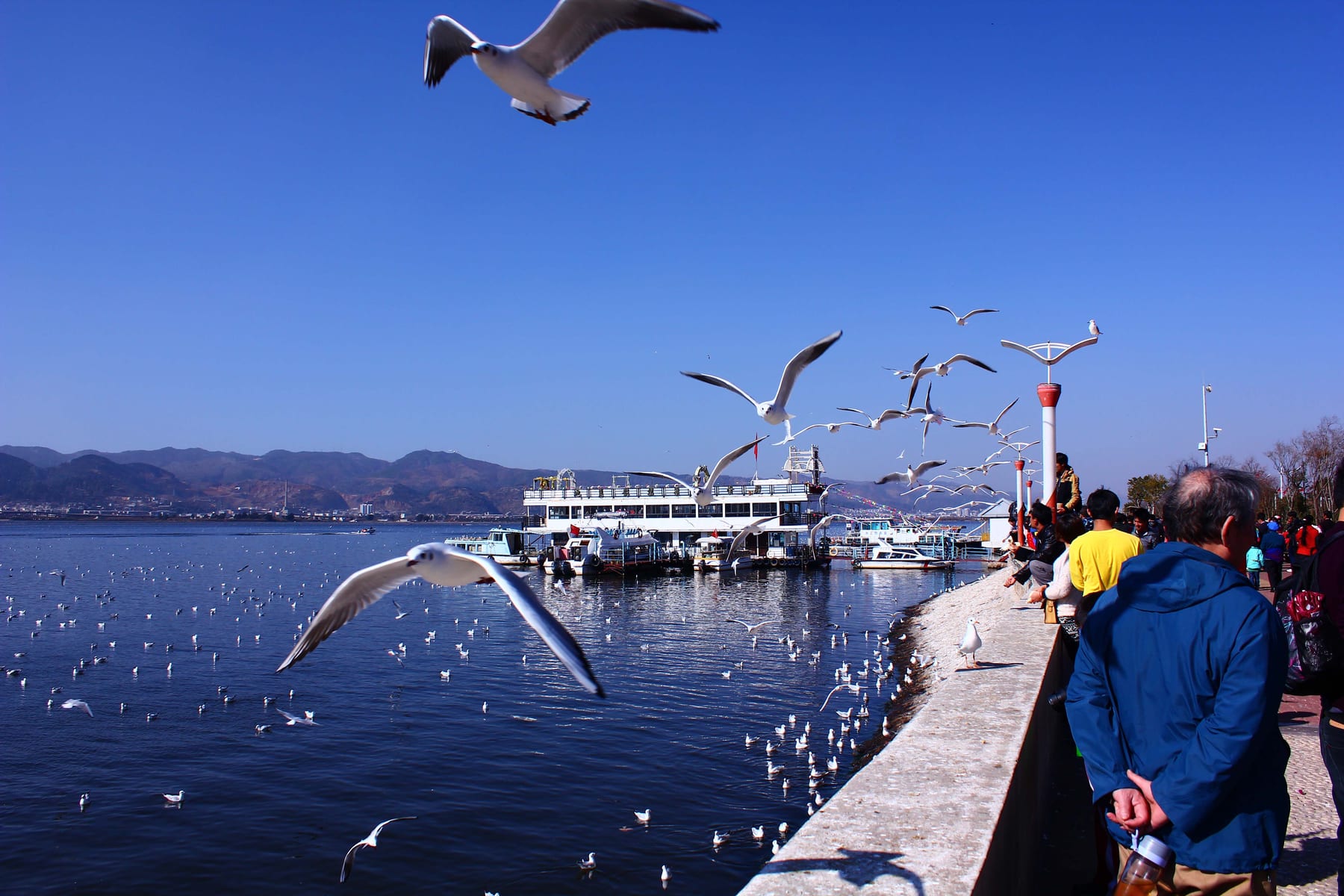
The park beside the dam is being rebuilt (work began in August 2026), so expect some fenced-off sections; the dam itself stays open. The Yunnan Ethnic Village is next door if you have children with you.
Haiyan Village (海晏村)
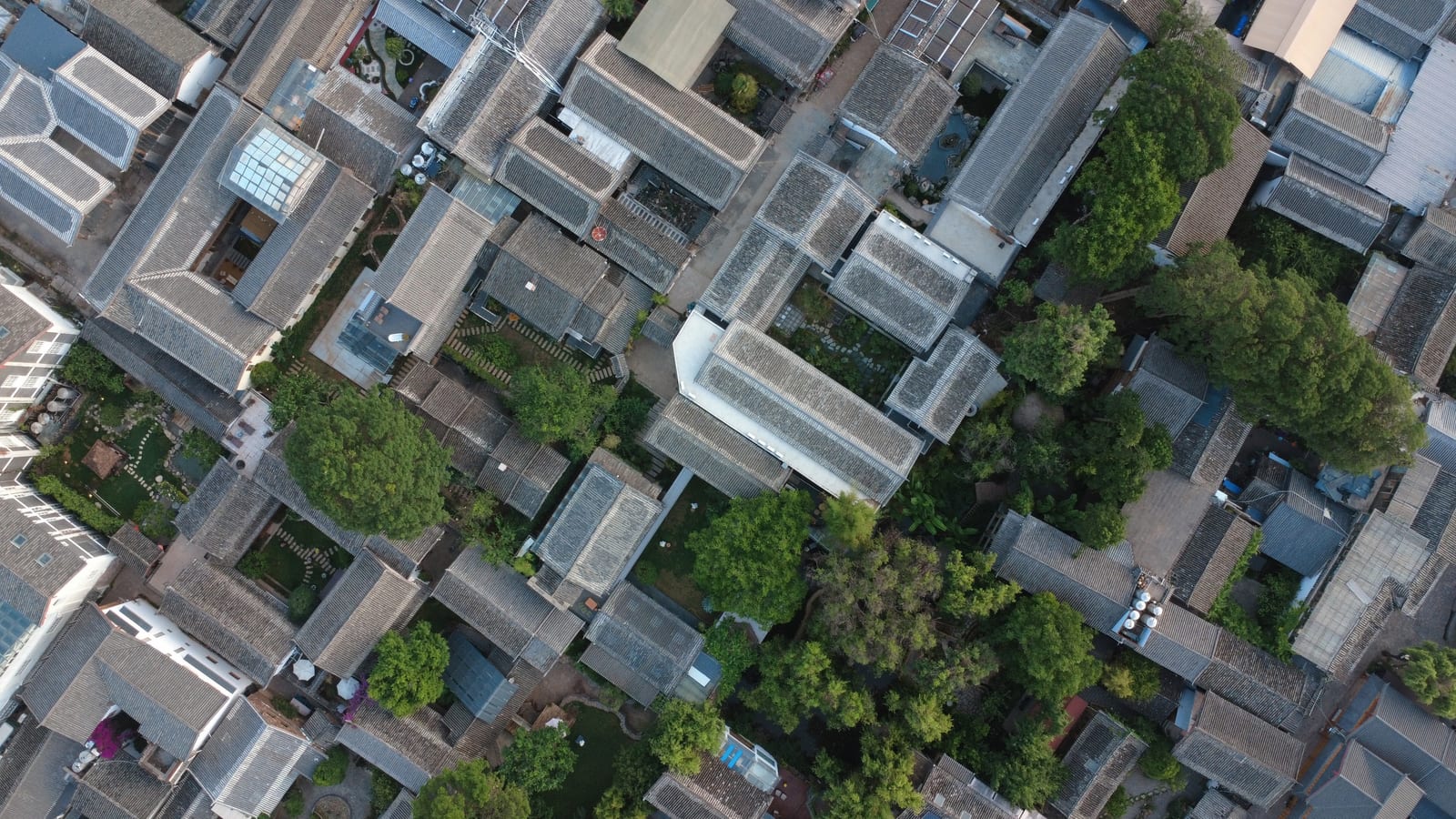
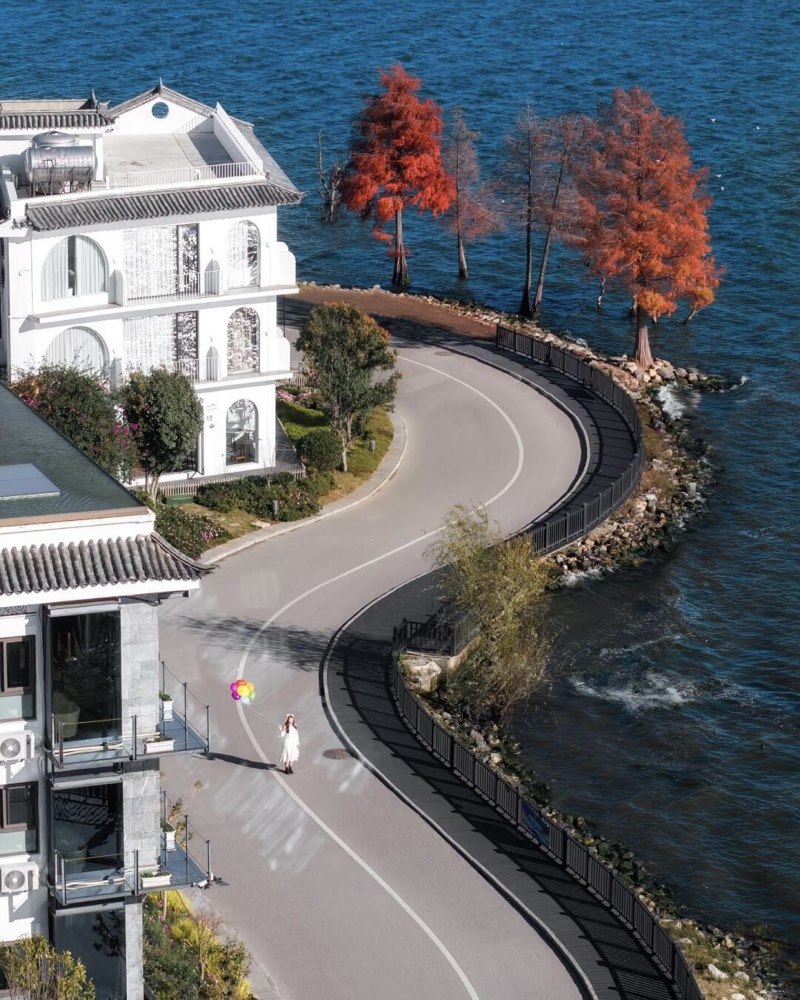
Over on the east shore, in Chenggong, Haiyan is a Ming-dynasty fishing village more than 600 years old — the last fairly intact one left on this side of Dianchi. A few years ago visitors noticed the sunsets from its old wharf, across the water behind the Western Hills, and word got around. The district has since cleaned up the river and the village, and more than a hundred cafés and guesthouses now fill its courtyard houses and bluestone lanes. It drew over two million visitors in 2024, so go on a weekday, mid-afternoon: walk the lanes, find a rooftop, and wait for the light.
How we’d spend two days in Kunming
- Day one, on foot: Yuantong Temple when it opens at eight, then down to Green Lake for the gulls and the dancers. Cross to the Military Academy (not Mondays), and lunch on Wenlin Street. In the afternoon, Metro Line 3 out to the Western Hills and the Dragon Gate.
- Day two, the lake: the Golden Temple early (in camellia season, especially), then Daguan Park or the gulls at Haigeng Dam. Finish with sunset at Haiyan Village.
Before you go
- Pay by phone. Entry fees are small and almost everything is paid by Alipay or WeChat Pay — set up your China travel apps before you fly. Several of these places are free.
- Holidays. Chinese New Year, May Day and the October Golden Week bring huge crowds to all seven. Weekday mornings are calm.
- Gulls. Buy the official gull food at the stalls; bread is discouraged.
- Getting around. The metro reaches most of these. A private guide makes the most of a short stay — handling tickets and timing, and explaining the long couplet and the temples. Here’s what a private guide actually does.
So where should you go?
- Only one morning: Green Lake and Yuantong Temple, on foot.
- One big view: the Dragon Gate on a clear day.
- Winter: the gulls at Haigeng Dam, then sunset at Haiyan Village.
- Gardens: the Golden Temple in camellia season.
- History: the Military Academy and the long couplet at Daguan.
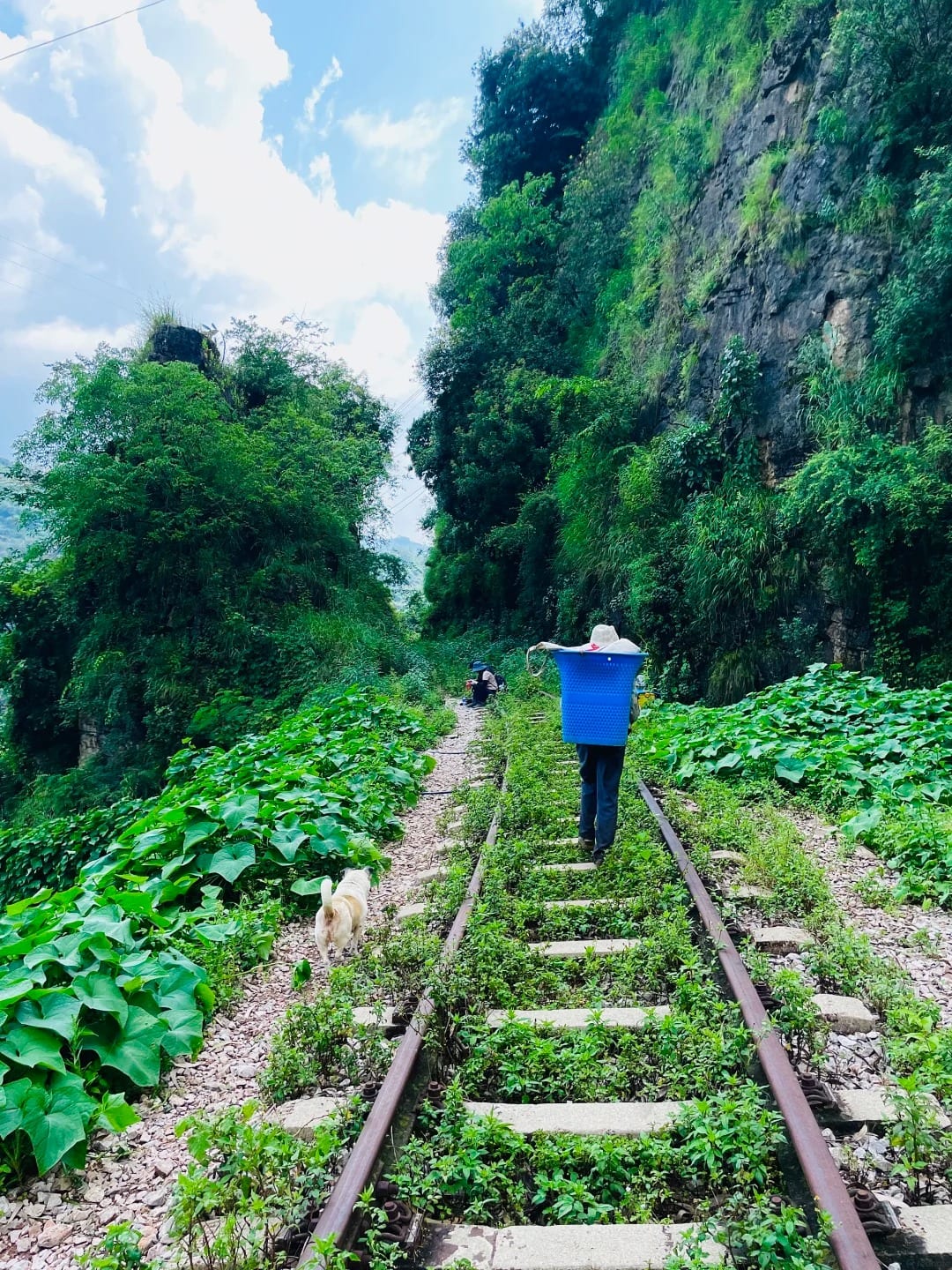
Kunming is also where our two-day Yunnan–Vietnam Railway & Fuxian Lake departure begins — any day you choose — on the 7:45 slow train from Kunming Station. Arrive a day early for the parks, then walk the 1910 Yunnan–Vietnam Railway and spend a night on Fuxian Lake. Or tell us your dates and we’ll build Kunming into a private Yunnan trip. For the bigger picture, start with our Yunnan travel guide.
Photos via Wikimedia Commons: the Dragon Gate path by Hermann Luyken, CC0; Green Lake by N509FZ, CC BY-SA 4.0; the Military Academy by Zhangzhugang, CC BY-SA 3.0; Yuantong Temple by xiquinhosilva, CC BY 2.0; the bronze hall by 江上清风1961, CC BY 3.0; camellias at the Golden Temple by XuasdYX, CC BY-SA 4.0; Daguan Pavilion by Kcx36, CC BY-SA 4.0; gulls at Haigeng by Zhangmoon618, CC BY-SA 3.0.





.jpg)


