← All journal entries
Guest Stories 7 min read

Gubeikou to Simatai: Three Days on the Wild Great Wall

A real Gubeikou to Simatai hike, walked in mid-October: original Ming brick, a village farm-stay under Jinshanling's gate, and a wall with almost nobody on it. What the three days were actually like.

There’s a brown sign near the end of the walk that sums the whole thing up. The Great Wall ahead is an un-opened area. Climbing is prohibited. Behind it, the wall keeps going anyway: over a ridge gone rust-red with autumn scrub, tower after tower, with nobody on it.

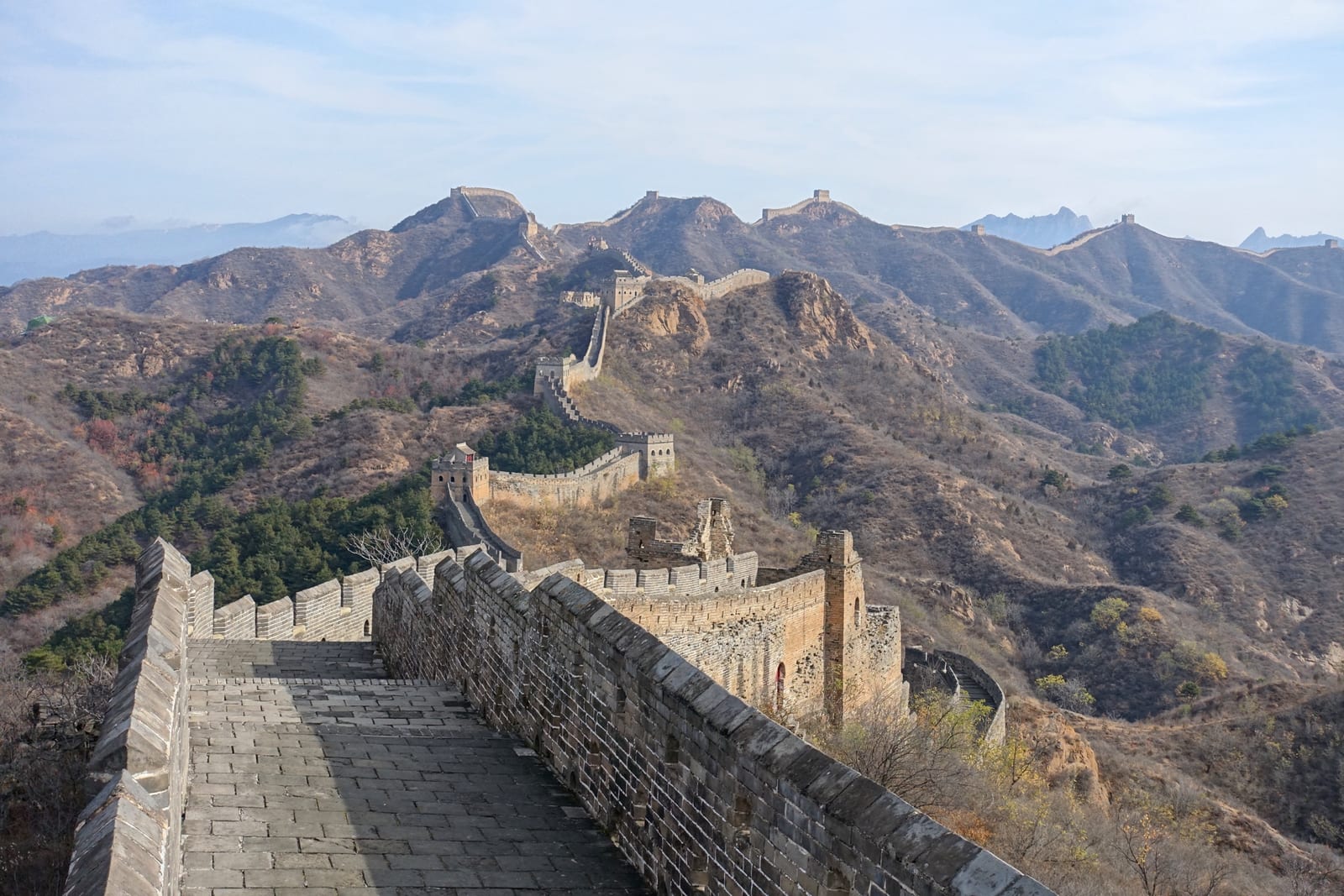
Most people who visit the Great Wall never get within a two-hour drive of a sign like that. They see it for an afternoon at Badaling or Mutianyu, on brick relaid for visitors, shoulder to shoulder. The Gubeikou to Simatai hike is the other wall: about thirty kilometres of original Ming brick north-east of Beijing, walked over three days, with the nights spent in a village at the foot of it.

In mid-October, a week after the National Day crowds had gone home, an active couple walked it with us as the opening of a 13-day trip. This is how their three days went: where the crowds weren’t, what the wall is really like underfoot, and what you’d need to know to walk it yourself.
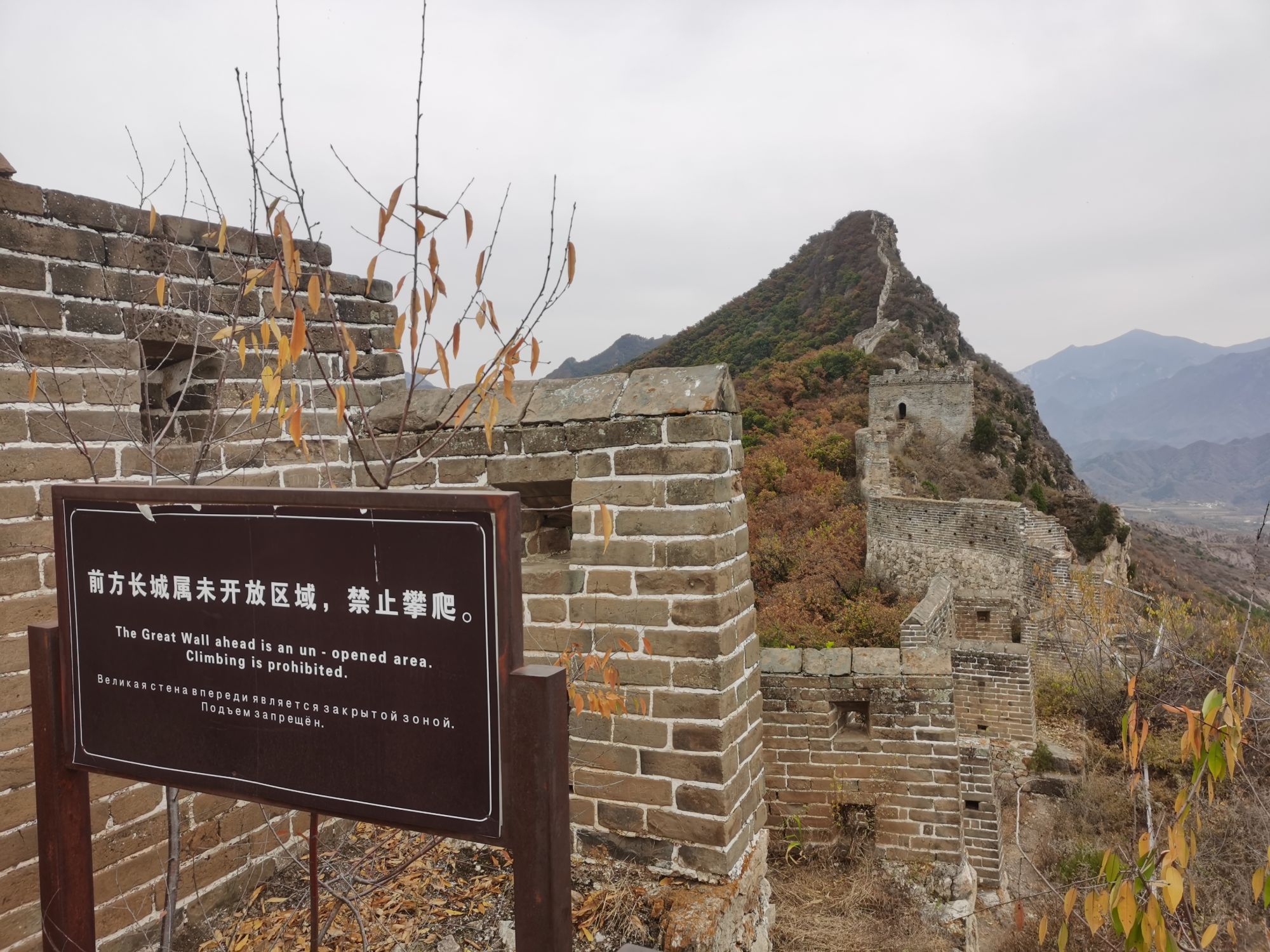
Where the open wall stops: a sign reading "The Great Wall ahead is an un-opened area. Climbing is prohibited", with the wild wall running on over an autumn ridge behind it

When to go: mid-September to the end of October is the best of the year on this wall — dry air, cool walking days, the ridges turning red and gold. Late April and May are the other good window. Plan around the National Day holiday, 1 to 7 October, when every wall near Beijing fills up. Our couple started on 14 October for exactly that reason.

DaySectionWalkingThe wallWho else is up there
1Gubeikou · Panlongshan ridge 古北口About 4 hoursUnrestored, roofless towersA handful of walkers
2Jinshanling, west to east 金山岭6–7 hoursRestored at the west end, wild to the eastBusier near the gate, then thins out
3Simatai, via Gubei Water Town 司马台3–4 hoursSteepest and most original of the threeTimed entry only

Day 1: Gubeikou, onto the wall nobody rebuilt

The guide and driver collected them from their Beijing hotel after breakfast, and the briefing happened in the car: about two hours north-east to Gubeikou, an old garrison town that has guarded this pass through the mountains for centuries.

Then straight up onto the Panlongshan ridge and east along the wall. This is the moment the trip changes gear. There’s no cable car and no crowd to queue behind. There’s the wall itself — original brick, worn smooth in places and broken in others — and towers with their roofs long gone, open to the sky. You walk on the history rather than a reconstruction of it.

They came off the wall at Zhuandu Pass (砖垛口), where the Gubeikou section hands over to Jinshanling, and it was a short drive to their base.
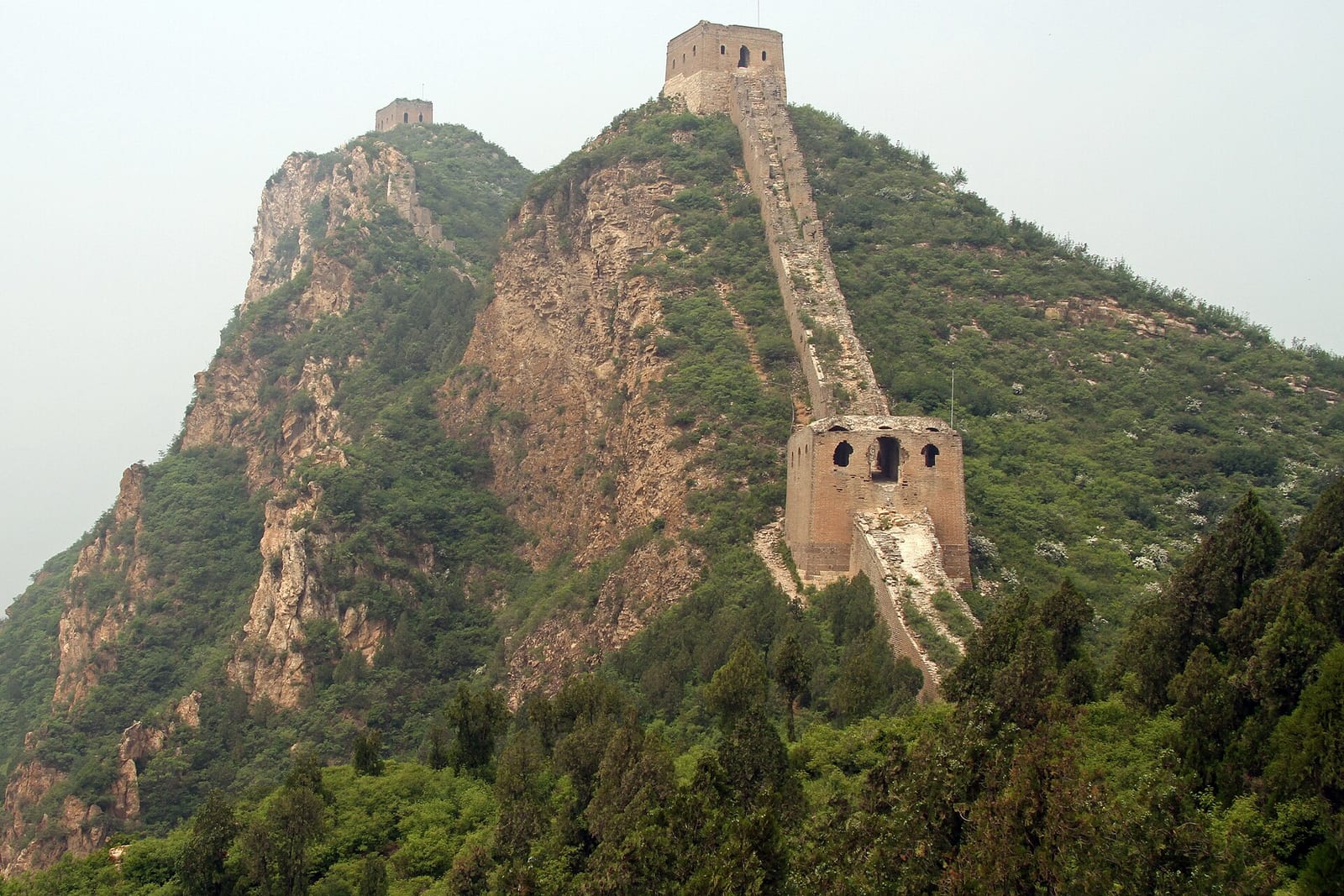
The unrestored Great Wall above Gubeikou climbing a steep ridge, one watchtower after another on the skyline

Nights under the wall, in Hualougou village

This is the part of the trip people don’t expect, and the part they talk about afterwards. Instead of a two-hour drive back to a Beijing hotel each evening, you sleep in a family-run farm-stay in Hualougou village, directly below Jinshanling’s ticket gate, just over the line into Hebei province.

It’s a village house, not a hotel. The twin rooms are simple and clean, with their own bathroom. Dinner and breakfast are cooked by the family, and from the courtyard you can see the line of the wall on the ridge above. In the morning the walk to the wall starts almost at the door. The couple in this story stayed three nights; the departure as we run it now is two nights, with the drive back to Beijing on the evening of day three.

Day 2: the whole Jinshanling chain

Day two is the long one, and the best: six to seven hours along the entire Jinshanling chain, west to east, starting at exactly the pass where day one ended. Nothing is skipped, and that’s the point of walking it as a relay.

Jinshanling is one of the finest surviving runs of Ming engineering anywhere on the wall. The western end, near the gate, has been restored, and that’s where most of the day-visitors stay. Keep going east and the restoration stops, the brick gets rougher, and the people thin out until it’s mostly you, your guide and the next tower. The steps are big and steep. Trekking poles earn their place.
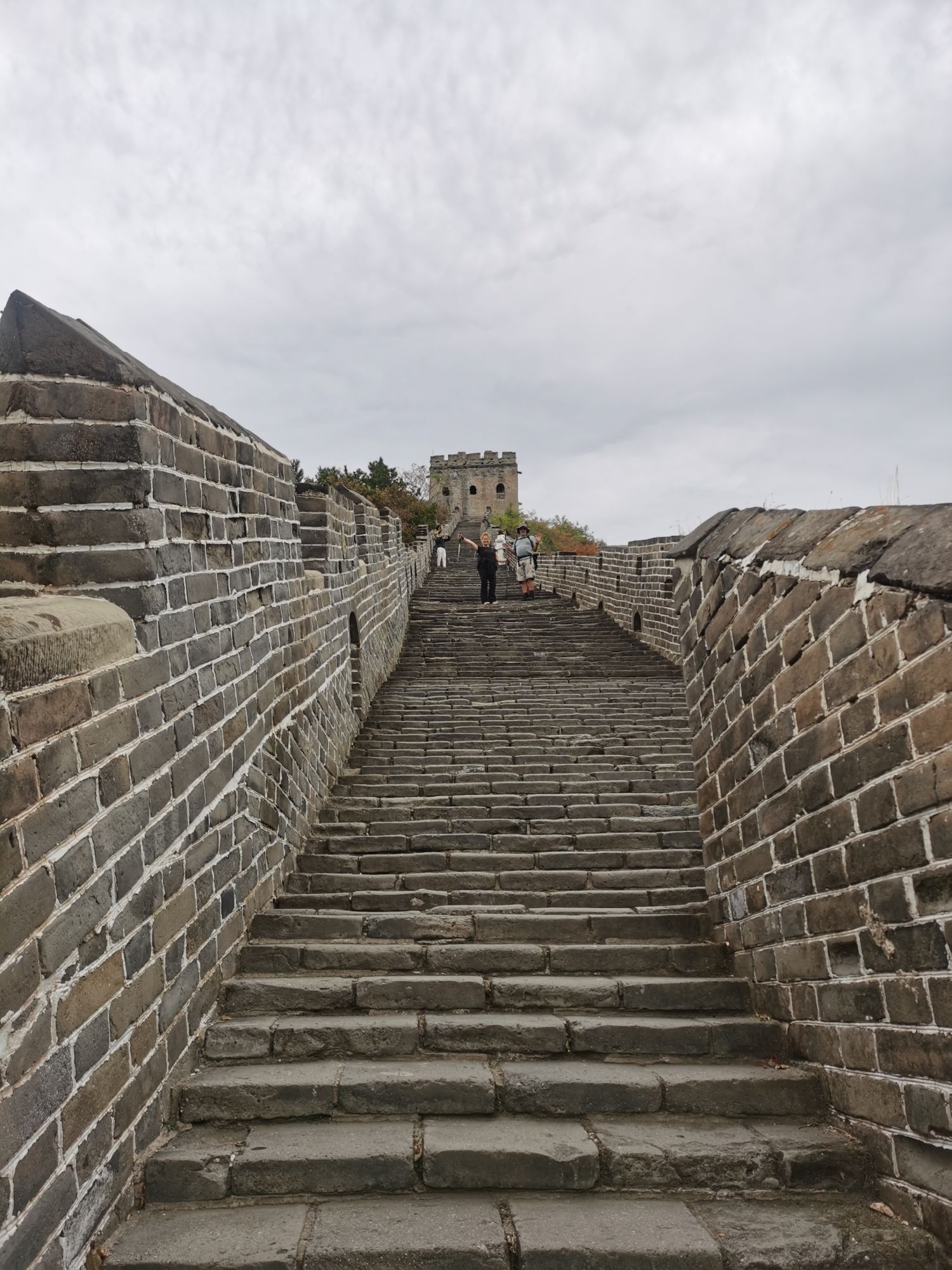
Steep Great Wall steps climbing to a watchtower under a grey October sky, two walkers waving from the top

Where the open wall stops

That brown sign marks the end of the wall you’re allowed on. Beyond it, the brick is crumbling and the drops are real, and some of the most photographed wild sections near Beijing, like Jiankou, have had access restricted after recent safety incidents. We keep to the open wall, with a ticket and a specialist wall guide, and we think that’s the right trade: you still get the original, unrestored Great Wall, without gambling on a collapsed step. If you’re weighing the sections against each other, our wild Great Wall comparison lays out Jinshanling, Jiankou, Mutianyu and Badaling side by side.

Day 3: Simatai, in through Gubei Water Town

Simatai has only one door: Gubei Water Town, a canal town built at the foot of the ridge, entered on a timed reservation the guide books ahead. Through it and up, you reach the section that was never rebuilt — the wall at its most original. It’s steep, narrow and exposed in places, climbing tower by tower towards the crags, with the whole Gubeikou valley opening out below.

Coming down is slower than going up. The steps are worn to rubble in places, with a chain rail on the drop side. Then the evening is down in the Water Town itself: canals, stone lanes, lanterns, and the wall lit along the ridge above.
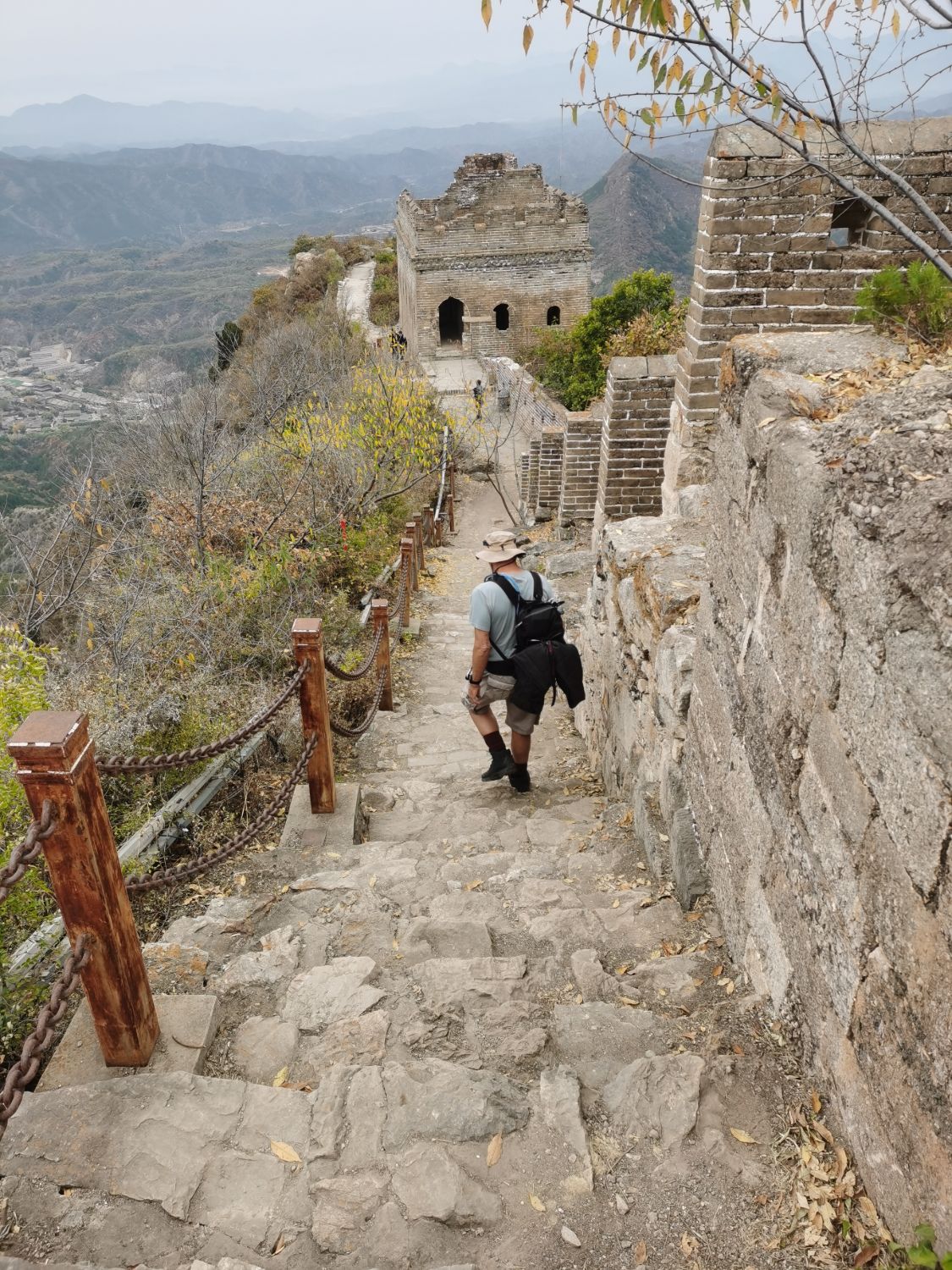
A walker heading down worn, unrestored steps beside a chain rail, a roofless watchtower and the valley below in autumn colour

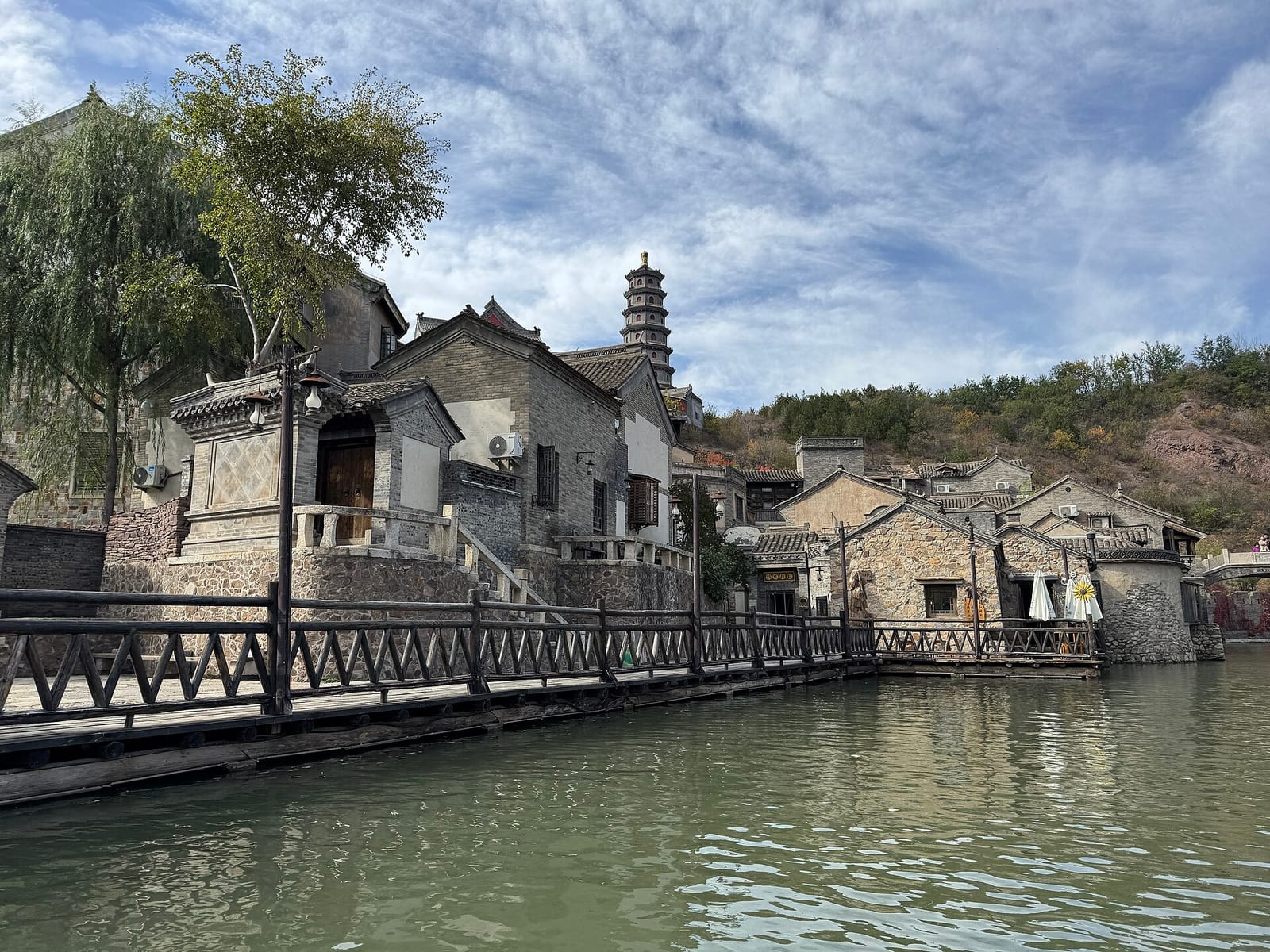
Gubei Water Town at the foot of Simatai: a stone-banked canal and a pagoda beneath the wall

What made it feel like the real wall

Three days is not a long trip. What makes this one feel so far from the Badaling version comes down to a few specific choices:

  • Distance. The wild wall starts beyond comfortable day-trip range from Beijing, which is exactly why it stays quiet.
  • Sleeping at the bottom. The farm-stay cuts out about four hours of driving a day and puts you on the wall early, while it’s at its quietest.
  • The relay. Each day starts where the last one stopped. You walk a continuous line of wall, not three separate photo stops.
  • The timing. Mid-October, after the holiday week, with cool air and autumn colour on the ridges.
  • A guide who walks this wall. A specialist wall guide sets the pace, knows the points where you can step off the ridge, and handles the Simatai booking — which is what turns a ruin into a walk you can actually do.

Before you walk it

  • Fitness. You need to be a confident walker who’s fine with stairs: thousands of uneven steps, up and down every tower. Day two is the test.
  • Kit. Boots with ankle support, trekking poles, layers and a wind shell. The wall is exposed, and October days start cool and grey.
  • What’s included. An English-speaking Great Wall guide for all three days, the vehicle out from your Beijing hotel and back, farm-stay nights with dinner and breakfast, packed lunches on the walking days, and every wall entry and timed reservation.
  • Price. From A$985 per person, twin share, for two to eight guests, on any date you choose. A single room is A$110 more.
  • Before you fly. Australian passport holders can currently enter China visa-free for short stays. Check the details in our visa-free entry guide, and set up payments with our essential China travel apps.

Where it fits in a longer trip

The walk starts and ends at a Beijing hotel, so it drops into any trip that passes through Beijing. The couple in this story went straight on: the high-speed train west to Xi’an for the Terracotta Army, a bike ride round the Ming city wall and a night on Huashan’s summit, then a flight to Zhangjiajie for four days in the stone forest.

That’s close to our Great Wall, Pandas & Avatar Mountains route, which already spends a day on the wall at Jinshanling. If you’d rather keep the classic first-timer’s line through China, the wild wall swaps neatly into Great Wall, Terracotta Warriors & the Li River in place of a day at Mutianyu.

Should you walk Gubeikou to Simatai?

If you can manage six or seven hours on steep, uneven stairs and you want the Great Wall as it actually survives, rather than as it was rebuilt, yes. It’s the best three days we know of near Beijing. If knees are a worry, or you’re travelling with young children or older parents, choose Mutianyu and its cable car, and don’t feel short-changed.

The Wild Great Wall departure runs any day for two to eight guests. Tell us your dates and we’ll check the guide and the farm-stay for you.
Quick answers

Common questions

01 How long is the Gubeikou to Simatai hike?

Three days on the wall. About four hours on day one along Gubeikou's Panlongshan ridge, six to seven hours on day two along the whole Jinshanling chain, and three to four hours on day three at Simatai, with plenty of stops. Each morning starts at the exact pass you came off the evening before, so no wall is skipped.

02 Is the wild Great Wall crowded?

Far less than Badaling or Mutianyu. The Panlongshan ridge above Gubeikou and the eastern end of Jinshanling see a handful of walkers on a normal autumn day; the busier stretch is the restored wall near Jinshanling's western gate. Simatai is entered only through Gubei Water Town, on a timed reservation. Avoid the National Day holiday, 1 to 7 October.

03 How fit do you need to be?

A confident walker who doesn't mind stairs. The wall is original Ming brick, steep and broken in places, with big uneven steps up and down every tower. Day two is the real test. Walking boots with ankle support and trekking poles make a clear difference, and the guide sets the pace and knows where you can step off.

04 Where do you stay on the wild wall?

In a family-run farm-stay in Hualougou village, directly below Jinshanling's ticket gate: simple twin rooms with their own bathroom, home-cooked dinners and breakfasts, and the wall on the skyline above the courtyard. It's a village house, not a hotel.

05 Can you add the wild Great Wall to a longer China trip?

Yes. The walk starts and ends at your Beijing hotel, so it slots into any trip that passes through Beijing. The couple in this story went straight on by high-speed rail to Xi'an and Huashan, then flew to Zhangjiajie.

Keep reading

More from the journal

Five Days in the Pu'er Tea Mountains: Mario & His Guest
Guest Stories

Five Days in the Pu'er Tea Mountains: Mario & His Guest

10 July 2026 · 6 min read

Two European guests, five green-season days across Nannuo and Jingmai — the monsoon that couldn't stop the tea, a cake pressed by hand, and a fire-pit evening inside the UNESCO landscape. A guest story.

Read article →
When Xin & Lorraine Walked Dali to Shangri-La — Their 14 Days in Yunnan
Guest Stories

When Xin & Lorraine Walked Dali to Shangri-La — Their 14 Days in Yunnan

21 April 2026 · 11 min read

A case study in private Yunnan travel — Xin and Lorraine's April 2026 trip, day by day. Dali courtyards, Shaxi market mornings, the Tiger Leaping Gorge upper trail, Songzanlin, and three days at the foot of Meili Snow Mountain. What ran, what we changed mid-trip, and the calls they never saw.

Read article →
Wild Great Wall: Jinshanling vs Jiankou vs Mutianyu vs Badaling
Travel Advice

Wild Great Wall: Jinshanling vs Jiankou vs Mutianyu vs Badaling

27 September 2026 · 7 min read

Four Great Wall sections near Beijing, compared honestly — which is crowded, which is risky, and why the wild wall we build walks around is Jinshanling.

Read article →
The Yunnan–Vietnam Railway: History & Where to Walk It
Yunnan

The Yunnan–Vietnam Railway: History & Where to Walk It

9 October 2026 · 8 min read

The French drove a metre-gauge railway from Haiphong to Kunming in 1910. The passenger trains have gone, but the tunnels, stations and bridges are still there — and you can walk the best of it.

Read article →
China Visa-Free in 2027: What We Know, and What It Means for Your Trip
Practical

China Visa-Free in 2027: What We Know, and What It Means for Your Trip

16 November 2026 · 4 min read

China's 30-day visa-free entry runs until 31 December 2026, and the decision on 2027 hasn't been announced yet. Here's where it stands, what it means if you're travelling with us, and what to do if it isn't renewed.

Read article →
Day Trips from Kunming: Stone Forest, the Old Railway & Fuxian Lake
Yunnan

Day Trips from Kunming: Stone Forest, the Old Railway & Fuxian Lake

13 November 2026 · 9 min read

Most travellers leave Kunming the morning after they land. Give it two more days: within reach are a karst forest, a 1910 French railway you can walk, Yunnan's deepest lake and the markets Kunming actually shops at.

Read article →
Shangri-La Off the Beaten Path: Five Places Worth the Drive
Yunnan

Shangri-La Off the Beaten Path: Five Places Worth the Drive

12 November 2026 · 9 min read

Most visitors see Shangri-La's old town, Songzanlin and Pudacuo, then leave. Here are five places within two and a half hours that they miss — Abujicuo, the Ren'an valley, Wudi Lake, Balagezong and Baishuitai — with honest drive times and when to go.

Read article →
The Caravan Table: Eating the Tea Horse Road in Yunnan
Yunnan

The Caravan Table: Eating the Tea Horse Road in Yunnan

9 November 2026 · 10 min read

Salt, ham and Bai cheese built the old caravan towns of western Yunnan. Here's the Tea Horse Road by the plate, from Xizhou to Tengchong, with the restaurants to book and the months that matter.

Read article →
Dali's Ancient Towns: Around the Lake, and the Ones Most People Miss
Yunnan

Dali's Ancient Towns: Around the Lake, and the Ones Most People Miss

8 November 2026 · 12 min read

Dali Old Town is the one everyone visits. Here are the ancient towns around Erhai Lake and in the valleys beyond — Shaxi, Fengyu, Nuodeng, Weishan and Midu's Mizhi — on one map, with honest drive times.

Read article →
Nujiang: The Valley Where Yunnan's Faiths Live Side by Side
Yunnan

Nujiang: The Valley Where Yunnan's Faiths Live Side by Side

13 October 2026 · 9 min read

A lamasery, French mission churches and Lisu hymns, all in one gorge at the end of the road to Tibet. The story of how Nujiang's faiths arrived, and the valley they live in.

Read article →
Fuxian Lake & the Yunnan Lakes Kunming Keeps for Itself
Yunnan

Fuxian Lake & the Yunnan Lakes Kunming Keeps for Itself

9 October 2026 · 8 min read

Everyone knows Erhai and Lugu. Kunming people spend their weekends at Fuxian, Yangzonghai and four quieter lakes south of the city. Here's what each is really like.

Read article →
Kunming's Parks & Temples: 7 Places the Locals Actually Go
Yunnan

Kunming's Parks & Temples: 7 Places the Locals Actually Go

9 October 2026 · 7 min read

Most travellers treat Kunming as an airport. Give it a day and see the city locals know: gulls on Green Lake, the Dragon Gate cliffs, a bronze temple and an old fishing village at sunset.

Read article →
Lijiang Ancient Towns: Why We Prefer Shuhe & Baisha
Yunnan

Lijiang Ancient Towns: Why We Prefer Shuhe & Baisha

28 July 2026 · 6 min read

Lijiang has three ancient towns, not one. The honest difference between Dayan, Shuhe and Baisha — and why we book our travellers into the quieter two.

Read article →
Little Chinese Everywhere Tours — Built With Boutique China
News

Little Chinese Everywhere Tours — Built With Boutique China

14 July 2026 · 3 min read

We're partnering with Little Chinese Everywhere on small-group Yunnan tours. Two journeys, groups of up to 8, first departure 10 September.

Read article →
Pu'er Tea in Yunnan: Where to Go and What to Taste
Yunnan

Pu'er Tea in Yunnan: Where to Go and What to Taste

8 July 2026 · 11 min read

Where Pu'er tea actually comes from — Menghai, Yiwu, UNESCO-listed Jingmai and Lincang — the five villages collectors chase, and how to taste them properly.

Read article →
Meili Snow Mountain Travel Guide: A Yunnan North Highlight
Yunnan

Meili Snow Mountain Travel Guide: A Yunnan North Highlight

6 May 2026 · 12 min read

A Meili Snow Mountain travel guide built from a recent client trip — sunrise on Kawagarbo, the Yunnan North circuit, and why we booked Poodom over Songtsam.

Read article →
China Visa-Free for Australians: What We Actually Get Asked
Practical

China Visa-Free for Australians: What We Actually Get Asked

17 April 2026 · 6 min read

China's 30-day visa-free policy for Australian passports is now approaching two years old. Here's what it means, what to ignore, and what the border actually feels like.

Read article →
What a Private Guide Does in Yunnan and Sichuan
Travel Advice

What a Private Guide Does in Yunnan and Sichuan

17 April 2026 · 8 min read

A private guide in Yunnan and Sichuan solves permits, altitude, weather, and access group tours can't reach. Here's what they do — and why it pays back.

Read article →
Shangri-La Hiking: 9 Trails Beyond Tiger Leaping Gorge
Yunnan

Shangri-La Hiking: 9 Trails Beyond Tiger Leaping Gorge

10 April 2026 · 12 min read

Tiger Leaping Gorge is only the start. Nine alpine routes across Shangri-La's high country, from day hikes to multi-day treks.

Read article →
Jiuzhaigou 2026: Crowds, Permits & Quiet Alternatives
Sichuan

Jiuzhaigou 2026: Crowds, Permits & Quiet Alternatives

7 April 2026 · 6 min read

Everything you need to know about visiting Jiuzhaigou in 2026 — daily quotas, booking windows, and the lesser-known parks most travellers miss.

Read article →
Yunnan's Ethnic Minorities: 7 Cultures You'll Actually Encounter
Culture

Yunnan's Ethnic Minorities: 7 Cultures You'll Actually Encounter

7 April 2026 · 6 min read

A grounded introduction to the Bai, Naxi, Dai, Yi, Tibetan, Hani and Miao people you'll meet on our Yunnan tours.

Read article →
West Sichuan Travel Guide: Beyond Jiuzhaigou
Sichuan

West Sichuan Travel Guide: Beyond Jiuzhaigou

2 April 2026 · 9 min read

The real West Sichuan is the sky road west of the park: Tibetan monasteries, alpine lakes, and villages where tourism barely touches the edges.

Read article →
Best Boutique Hotels in Dali, Yunnan (2026)
Stays

Best Boutique Hotels in Dali, Yunnan (2026)

29 March 2026 · 6 min read

Our favourite boutique stays in Dali for 2026 — from lakeside courtyards on Erhai to restored Bai mansions in the old town.

Read article →
Essential Apps for Travelling in China (2026 Guide)
Practical

Essential Apps for Travelling in China (2026 Guide)

25 March 2026 · 3 min read

The 2026 China app kit — payments, maps, translation, what replaced Uber, and the tricks to make it all work on a foreign phone.

Read article →
Yunnan Travel Guide: Six Regions Explained
Yunnan

Yunnan Travel Guide: Six Regions Explained

23 March 2026 · 9 min read

A complete orientation to Yunnan for first-time travellers — what each region is famous for, how long to spend, and when to go.

Read article →